Dear Sue Farlinger:
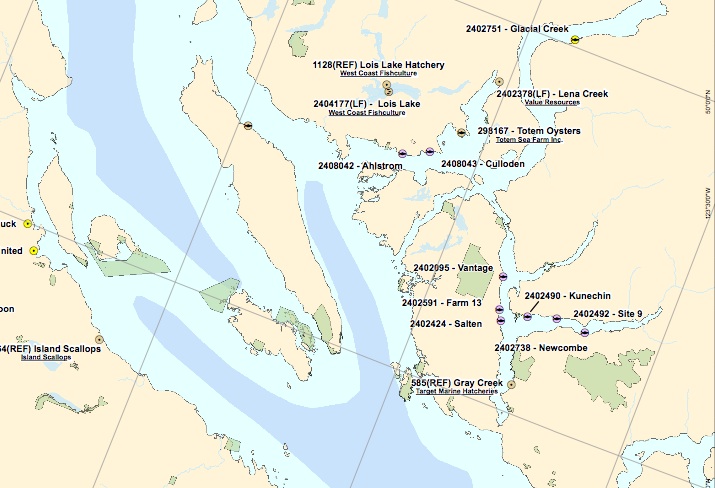
Today, Grieg Seafoods is reporting an outbreak of IHN at their Culloden salmon farm near the entrance to the Fraser River. Earlier this year Grieg reported IHN at Ahlstrom. They cancelled that report, but this outbreak less than 5km away makes us wonder if that cancellation was valid.
Cohen Commission Technical Report #1 by Dr. Michael Kent on pathogen threats to Fraser sockeye states: “I designate the following pathogens as potential “HIGH RISK,: IHN virus…The IHN virus is well recognized as a lethal pathogen to fry sockeye salmon in freshwater.” Dr. Kent also states: “… recent evidence suggests that there is variability in the virulence of this virus…”
While IHN is a locally occurring virus, your scientist, Dr. Kyle Garver testified at Cohen that a single salmon farm can shed 650 billion infectious viral IHN particles an hour. IHN is a reportable disease and the OIE document on IHN states a few facts we should all be aware of:
Younger fish are the most susceptible to the disease
“once IHNv is introduced into a farmed stock, the disease may become established among susceptible species of wild fish…”
Infection often leads to death in salmon
primary infection is fish to fish (horizontal)
depending on the strain, outbreaks can be chronic or explosive
The only control method is avoidance
Download 2.3.04_IHN copy.pdf (211.2K)
Looking at the attached map, if the farm is shedding trillions of viral particles a day, the wild inbound adult sockeye are passing this virus over their gills just before they enter the nursery grounds where last year’s sockeye run are rearing as fry. These young fish are not only the most susceptible to IHN, they could also become carriers, spreading it through the North Pacific to other Canadian and US runs, similar to the threat from the European viruses we are tracking.
I am writing to ask who exactly in DFO Fish Health is going to be tracking this virus in the inbound Fraser sockeye passing this infected farm? What lab did this diagnosis? What clade and strain of IHN does this farm have so we can track it as well. What is known about the virulence of the Grieg IHN strain to Fraser sockeye fry?
I look forward to hearing from you. I will follow up with the person in DFO Fish Health who is tracking this outbreak. I will be adding IHN to the list of viruses we are looking for this summer and will keep you informed of my results.
Alexandra Morton and Anissa Reed
Department of Wild Salmon

n
Comments
3 responses to “Letter to Sue Farlinger”
Assessment of the risk of the IHN outbreak in farmed salmon on migratory sockeye is central to the whole issue of fish farm risk.
There are plausible arguments on both sides.
While I do believe the IHN outbreak does present an irreversible risk to sockeye runs, I would be prepared to accept independent research panel results, not under the aegis of the DFO, the BC government or the fish farms.
That is, provided the independent expert panel is acceptable to both sides of the argument.
Alas, scientific evidence seems to be the first casualty of any IHN outbreak. A well rehearsed communications strategy slips into action, the regulators are (seemingly ) silent and the opportunity for reliable scientific evidence slips away.
And we are expected to believe the DFO are guardians of the public interest?
-30-
As it turns out DFO are not the guardians of the public interest but are guardians of the Fish Farms. All hail Minister Ashfield the God of the Fish Farms.
Quote: “I will be adding IHN to the list of viruses we are looking for this summer and will keep you informed of my results.”
Not ground breaking science, Alex. IHNV can be natually found in Pacific Salmonids (especially Sockeye) which are more resistant to the virus – having been exposed to background levels for centuries. It is important to note that there is a big difference between having a virus and developing a disease. Just because you have the virus doesn’t necessarily mean that disease is a sure bet.
Wild fish are at most at risk of IHN when they are fry or alevins. How can wild juvenile salmonids be carriers of IHNV if they are the most susceptible life stage to IHN? Unless you can show something different what you say makes no sense. The risk of outbreak is most common at salmon hatcheries, spawning channels and fish farms (IHN is lethal to Atlantic Salmon). You do not normally get this disease outbreak in streams because the host density is not like what you would find at salmon hatchery, spawning channel and a fish farm. Lastly, the distribution of IHN goes beyond our borders – from Alaska to California. It is not exclusive to places that have fish farms.
I can tell you right now that you are likely going to find IHNV in many samples you come across, but those adult fish are carriers IHNV rather than dying of IHN. If you enjoyed a wild Sockeye with your friends on the river recently it likely had IHNV.