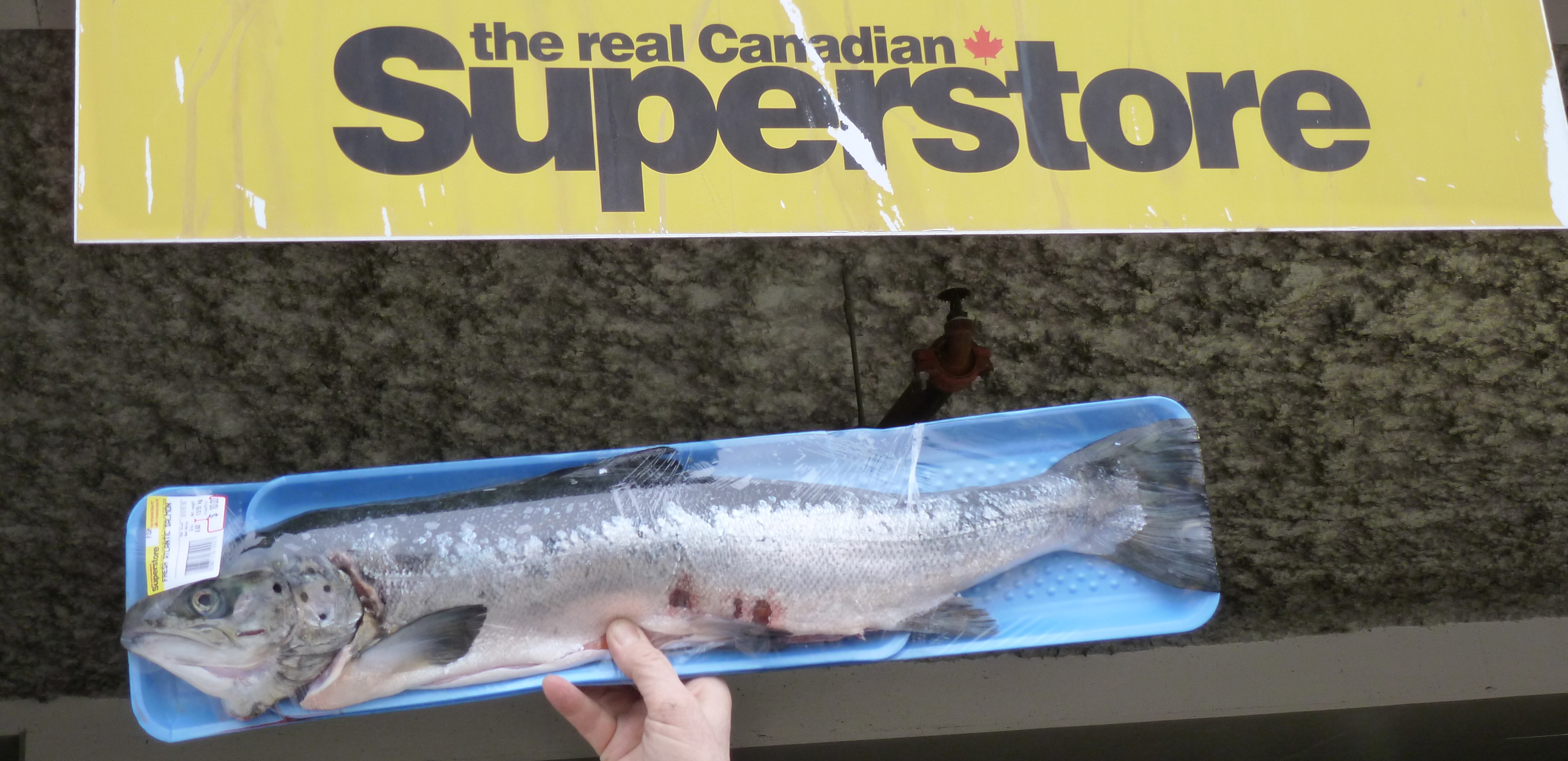
A major TV news station aired an investigative piece a couple of nights ago on their evening news show, about Kudoa infested farm salmon fillets for sale at COSTCOs. The reporter goes undercover to interview a COSTCO employee:
Kudoa is a flesh borne farm salmon parasite that liquifies the flesh of the fish after it is killed. DFO has tried to help the industry figure out how to prevent it: but Kudoa caused $4 million dollars (NOK 23 million) in losses for Marine Harvest. Download MHC Kudoa 23 NOK.pdf (1777.2K)
Many people are asking if it is healthy to eat Kudoa. A different species of Kudoa was related to food poisoning in Japan. I am unclear if tests have been done on the species that has become epidemic in BC farm salmon. Best to write to Health Canada.
Response from the Union of BC Indian Chiefs.
In another development, while the governments of Canada and BC refuse to acknowledge that BC Atlantic farm salmon are testing positive for highly contagious and lethal European salmon viruses this note on their website was brought to my attention.
There is no treatment for these European viruses and unless they are referring to other “introduced” pathogens I have not found yet, I can only imagine they are considering culling wild salmon that test positive for European viruses to protect the farm salmon. If you want to investigate this please write to: Dr. Laura Richards, Director General of Science DFO Pacific Region. Feel free to cc me.
I hope you will consider joining over 11,000 people in asking supermarkets to stop selling diseased farm salmon. I don’t see any other way to deal with this issue. Every other region in the world that encounters these viruses has taken action – except BC – which is the only salmon farmed region in the world with an extremely valuable wild Pacific salmon fishery at risk. Our governments are immobilized caught between aggressive lobbyists and trade laws.
I am working on a solution to government’s abandonment of BC wild salmon – more later.
Comments
3 responses to “CTV NEWS FARM SALMON DISEASED”
This poses a regulatory dilemma.
One one hand, the farm fish advocates tell us that Kudoa is naturally widespread, does not present a human health risk. I would have preferred if the Canadian Food Inspection Agency epidemiologists, acting in their professional capacity, were willing to stake their professional reputations to stand by that assertion.
So far, radio silence. Which provides little comfort to ordinary citizens.
On the other hand, the farm fish companies have been slow to reveal the Kudoa problem (had it not been for some of their annual reports, many of us would never have known of the issue). Further, if there is a marketing issue with BC farmed salmon, and the public may perhaps be sold sub-standard products, it would not be surprising if the general public perceived a health risk, even if the farm advocates are correct that there is no health risk.
Market risk and biological risk are facts of life in the farmed fish industry. The economies of scale that come with fish pens provide a natural amplification of biological risk. Even if Kudoa is naturally occurring in BC waters, it would be especially troubling if the economic fate of the farmed fish industry lies not with the cut and thrust of democratic debate but the amplification of a natural parasite in the fish pens.
There is only one real answer.
Full and frank disclosure by the DFO, the CFIA and the fish farm organizations. At the very least, identify the ecology and distribution of the Kudoa parasite in BC waters. At least it would avert credibility risk for the fish farm industry.
-30-
Helmsdale, when you are willing to provide some actual evidence that Kudoa (which along with Henneguya is natually occuring in BC waters and salmonids) is being “amplified” by BC fish farms I would imagine you will have a much wider audience willing to listen. Until then I will default to the people that know what they are talking about.
I agree that full and frank disclosure is important. For instance, I am still awaiting to see Ms Morton’s latest lab results on reoviruses and alphaviruses. It is great to see that you support transparency, Don.
@ Steve
The tragedy of the current fisheries regulation is that independent research and assessment is sparse (and the DFO is essentially derailed by recent funding cuts).
Probably the fish farm industry itself is the one group that understands the marine ecology of the Kudoa parasite (and the fish farm industry is not saying anything). The DFO scientists, if they are still employed, are underfunded and under the usual federal restraints on scientific comments.
I am not a marine biologist and rely on independent studies for information.
For instance is the Kudoa parasite concentration triggered by salinity differences? Is it transmitted from one host to another or through intermediate hosts? Are genetically different Atlantic salmon more vulnerable than native species? Are Kudoa concentrations triggered by interaction of faecal matter with native species? Is Kudoa indirectly transmitted from sea louse to salmon and back again?
These are all legitimate scientific questions.
No one is answering the questions publically.
Given that the Kudoa issue is a major economic risk to the fish farms and their host communities, some public knowledge is clearly prudent. And the DFO is essentially sidelined by their fiscal situation.
And biological magnification in fish farms?
Quite simply, regardless of the origin of Kudoa, the biomass concentration in fish farms facilitates host to secondary host transfer, or host to intermediary to secondary host transfer. Biological magnification is an established risk element of fish farming world wide .
I am quite confident it happens in BC as well.
-30-