Marine Harvest
“In recent years, this stock has performed terribly. In 2000, the stock traded as high as NOK 2,208.56, versus NOK 3.00 on Jun/1/2012” (Wright Investor’s Service Report on Marine Harvest see below).
Download Wright Investors’ Service.pdf (236.8K)Download Marine Harvest Q1 2012.pdf (3929.4K)
—————————————————————————————–
Nov 2011 “Marine Harvest’s ability to honor loan conditions is being called into question after third-quarter net income declined 97 percent”
“Marine Harvest has a lot of debt and they could be in breach of their covenants in a couple of quarters. They will lose money — most likely it won’t improve next year.”
“Marine Harvest plans to cut 2012 capital spending by 600 million kroner to about 400 million kroner by closing some sites and reducing young-salmon stocking in Norway, Canada and Chile, according to Chief Financial Officer Joergen Andersen. It may cut jobs in Canada. ”
“They are now doing things to improve their balance sheet, but there are just limited things they can do,” Skagen’s Porter said. “The industry outlook looks weak.” Bloomberg
However, beginning in 2014 Chile is not going to allow companies to hold salmon farm licences indefinitely without using them. The companies will be forced to stock their sites and this runs counter to the need to cutback on the number of farm salmon on the market to try and bring the prices back up to a profitable level. (Thomson Reuters Streetevents Edited Transcript Marine Harvest ASA Earnings Presentation May 09, 2012).

While the Norwegian salmon farming industry operating in many countries is suffering from politics (China refusing Norwegian farm salmon due to the Nobel Peace Prize award to Chinese dissident Liu Xiaobo), a global glut of farm salmon on the market and disease and sea lice issues, Canada is the least profitable region where they operate.
“… in our Canadian operation, we have broke even. It’s not great, but we’ve said we’re working on structural change in Canada.” Download Transcript MH Earnings.pdf (285.6K)
 In 2009, I met with the previous CEO of Marine Harvest in Norway. She asked me, “what do you want?” When I said, “you have to move your industry out of the narrow Fraser sockeye migration route off Campbell River,” she said it could not be done, because their share price must rise every quarter. However, today Marine Harvest is moving farms from exactly that area trying escape a parasite that liquifies salmon flesh (Kudoa). People don’t want to consume their salmon through a straw.
 Kudoa, the white balls in this picture, releases an enzyme that liquifies the flesh after death. Salmon farms could certainly be enhancing this parasite similar to how they enhance sea lice, viruses and bacteria
“Kudoa is a typical customer claim. At 4Q11, Marine Harvest continued to report Kudoa challenges linked to the Campbell River area…. The company will concentrate production at the best sites, while other sites will be closed down in order to improve biological performance.” Download MHG4Q11update080212 copy.pdf (884.4K)
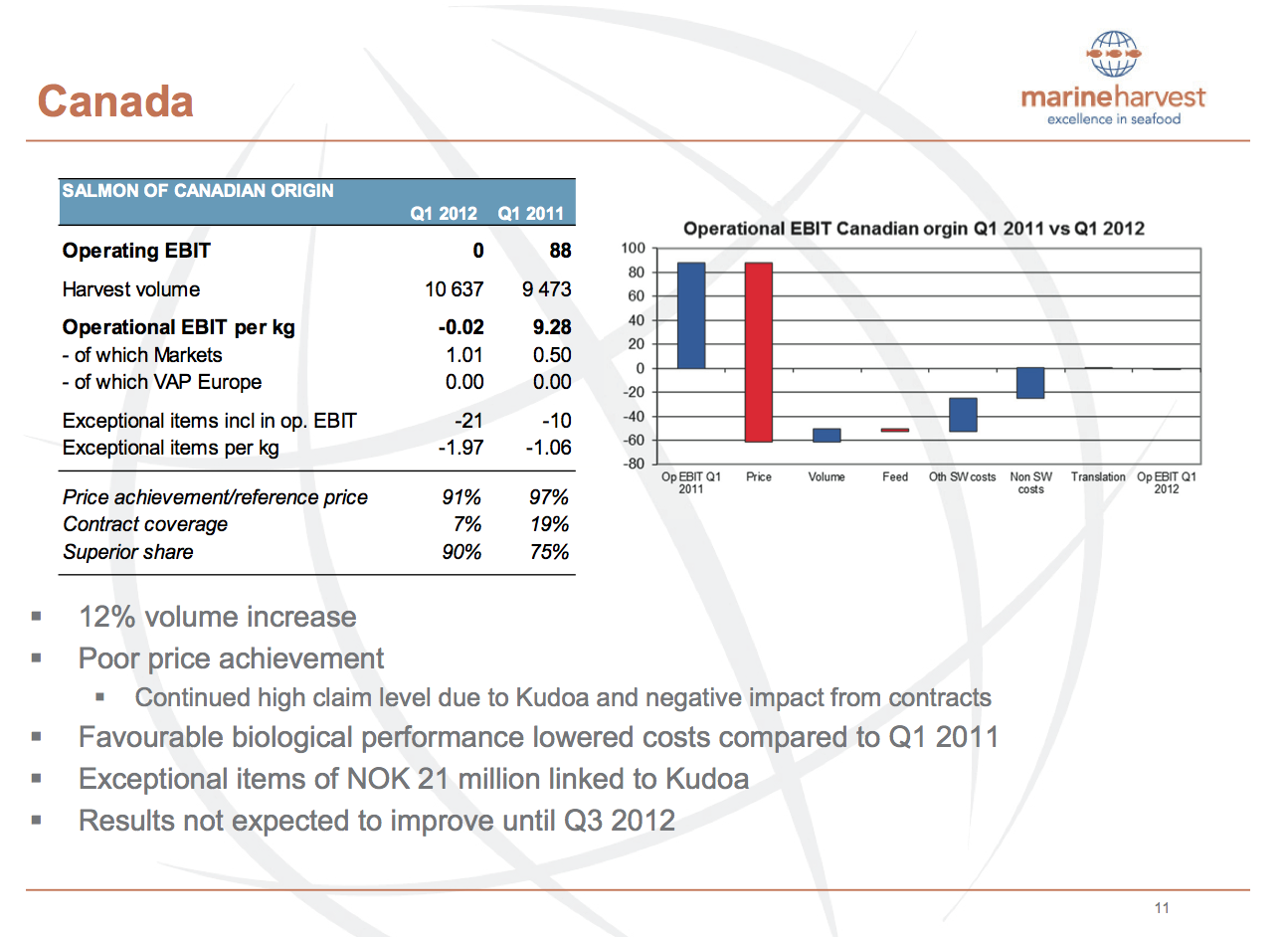
Download Marine Harvest Q1 2012.pdf (3929.4K)
_______________________________________________________________________________________
“For Marine Harvest Canada, the 2011 profit was affected by exceptional customer
claims and discards at harvesting totalling NOK 67.7 million due to the parasite Kudoa thyrsites. A restructuring plan for Canadian operations led to restructuring costs of NOK 23.4 million“
“Operating revenues for Marine Harvest Canada were NOK 1 182 million
in 2011 (NOK 1 371 million). The average price achieved in CAD was 11% lower than in 2010 due to high presence of Kudoa combined with a general reduction in the market price. Total costs related to discards and claims as a result of soft flesh (Kudoa), amounted to NOK 68 million/NOK 2.00 per kilo harvested in 2011 (NOK 24 million/0.72 per kilo harvested).”Download MH_AnnualReport_2011_Web copy 2.pdf (6264.7K)
People in many countries have been ignored when they have asked these companies to reduce the size of their farms in lochs, fjords and inlets. However, now that they are trying to save themselves Marine Harvest has removed almost 7.5 million farm salmon from the ocean.
“...the Group therefore decided to initiate actions to protect the 2012 cash flow. The first action was to reduce the smolt stocking by 3.8 and 7.5 million smolt for 2011 and 2012 respectfully.” Download MH_AnnualReport_2011_Web copy 2.pdf (6264.7K)

Empty Marine Harvest salmon farm near Campbell River.
Politician after politician has repeated – salmon farms make jobs. This has been the standard response to any effort to simply move the industry away from wild salmon to preserve the numerous jobs relying on wild salmon. But today, Marine Harvest reports they are laying people off to try and preserve the company.
“We strongly regret the approximately 60 job losses that result from these changes, but it is necessary to preserve the future of our company.” Vincent Erenst Wharfside Marine Harvest Newsletter
Not only are workers loosing their jobs, in their first quarter report, 2012, Marine Harvest suggests there will be no dividend paid to shareholders this year (page 23) Download Marine Harvest Q1 2012.pdf (3929.4K)

While this company is facing oversupply worldwide, Marine Harvest blames BC for its problems because they were not given even more of the ocean to to increase production. I realize corporate schemes are hard to understand, but this is hard to understand.
In an effort to bolster their sinking shares, Marine Harvest is buying up their own shares.
“Marine Harvest ASA has acquired 409 688 own shares during 2011 through a voluntary offer and a compulsory acquisition to shareholders with less than 1 000 shares.” ReutersDownload Q4:2011 Marine Harvest.pdf (1505.9K)
_________________________________________________________________________________________
Despite closing farms, buying their own shares, harvesting more fish, stocking 7.5 million less smolts and laying people off – Marine Harvest, the biggest salmon farming company in the world and the biggest company in the 98% Norwegian salmon farming industry in BC – is still going down.
“The world’s largest fish farmer, Marine Harvest, said first-quarter operating profit fell sharply even as harvested volumes were ahead of plan as salmon prices fell.” Reuters
Desperate times seem to spawn desperate measures. Once again trying to get bigger when they are already too big to survive.
SCOTLAND, UK – Marine Harvest has been accused of offering “bribes” to the islanders of Colonsay to get them to agree to a controversial plan to turn their waters into a giant fish farm, reports Herald Scotland.
The Norwegian firm has promised the 120 residents of Colonsay, to the north of Islay, £50,000 up front and £10,000 a year thereafter if they vote for 12 salmon cages to be moored 1500 metres off their east coast, reports Herald Scotland. It would be the island’s first commercial fish farm. thefishsite
Despite the cash flow issues, Marine Harvest surprised the aquaculture world by saying they are thinking of diversifying into feed production.
Mainstream
Mainstream, owned by Cermaq is also finding BC negative drag on corporate profits:
While Cermaq reported an EBIT of NOK 101 million, their BC operations reported a negative EBIT pre fair value of NOK 1.6 million, despite “certain cost reduction programmes.”

Cost – cutting is worrisome – what are they doing less of? Surely all precaution is being taken with their fish, but I already know from reading the Cohen documents that nobody can look after the wild salmon in the face of this industry. If anyone inhibits the ability of these corporations to make money, the wrath of the WTO looms. Who exactly is making sure that as these companies cut corners it is not at the expense of the wild fish just outside the pens… fish that are competing in an already over-saturated market. Nobody, is the answer to this question, because nobody is allowed to.
Grieg
“Biological production in Canada was good throughout the first quarter. An unusually severe prevalence of winter ulcer has resulted in an exceptional downgrading of quality which in itself has contributed to the weakened first quarter results. A cost reduction programmed has been initiated in Canada with the focus on reducing structural costs“
“High prevalence of winter ulcers caused unusually high downgrades and contributed negatively to profitability “Download GSF_Q1_2012_presentation.pdf (5226.5K)

I tested a number of BC farmed Atlantic salmon last winter with ulcers like these on them. They were positive for the piscine reovirus, causative virus of Heart and Skeletal Muscle Inflammation, a disease that attacks the heart of salmon, stunting their growth and if it spreads to wild salmon, might reduce their ability to swim up a river.
I wonder if the Grieg fish with “winter ulcers” were reared in same farms as the so called Skuna Bay product Grieg is selling to the U.S?
Again – it would be good to know what “cost reductions” mean to wild salmon.
Risk
In all the financial reports I read researching these companies, none appears to have mentioned to their shareholders that BC farm salmon are testing positive for the ISA virus, which caused salmon farmers $2 billion in damages in Chile 2007-2010. I don’t know if the shareholders know that these test results caused the Cohen Commission into the decline of the Fraser sockeye to re-open and there we found DFO has been hiding ISAv positive test results in the most endangered Fraser sockeye stock since 2004.
Now we also have positive test results for piscine reovirus, which stunts farm salmon, weakening their hearts, and positive tests for Salmon Alpha virus (causes Pancreas Disease), which is causing serious financial losses in Norway and Scotland.

Researching the Norwegian salmon farming industry has given me insight into the increasingly unreasonable denial that there is a serious issue with European salmon viruses in BC – just like everywhere else these companies raise Atlantic salmon in net pens. I hope this information will give people reason to pause and think about what cards we are holding in this global poker game.
We are risking all for an industry that is not only failing, it is failing most dramatically right here in BC. The Chilean divisions of Marine Harvest and Cermaq are escalating and that is what is driving global farm salmon prices down. These companies are competing with themselves. The huge 2007-2010 ISA epidemic in Chile significantly raised the price of farm salmon enormously worldwide. Everyone stocked their farms as fast as they could hoping for a few years of high prices, but the Chilean banks pushed Chilean operators to restock rapidly and so everyone was caught with too many fish in their pens. Now Chile is going to demand the Norwegians stock their licences in Chile, even though there are too many farm salmon on the market. British Columbia is the region of greatest loss to the Norwegians using coastlines around the world to grow “their” fish. Politicians in strong support of this industry such as North Vancouver Island MP John Duncan, Minister Keith Ashfield and Nova Scotia Premier Darrel Dexter who is giving the salmon farming industry $25 million to expand might be giving people misleading and false confidence to invest in a dying industry.
DFO invested in cod fishing gear and some believe they kept the North Atlantic cod fishery open to recoup their investments. I put quotations around “their” fish, in the previous paragraph because legally it is unlawful in Canada to own fish in the ocean. No one has challenged their ownership. Do the shareholders of this industry know this?
To a biologist this global gambling is a form of addiction and insanity. To risk a wild fish that powers this province in every way, financially, food security, ecologically and spiritually, for a dinosaur of an industry losing its balance, desperately addicted to growth even as it threatens its own survival, is going to pull entire ecosystems down with it. Our governments are assisting in this destructive process. Ultimately the consumer is the only one who can stop this. The next time someone tells you these massive Norwegian operations are good for the economy ask them to read this and get back to you.
You can sign this petition to the supermarkets

Comments
14 responses to “How Viable is Salmon Farming?”
Well, I guess it’s good news?
If the farms won’t leave because it’s the right things to do, then perhaps they will leave because they can’t make a buck…
We need our wild salmon.
If this how they end so much the better. When their tenure is up they should be gone for good. Atlantic salmon is an ivasive spieces on the West Coast and should have never been allowed here in the first place.
Leave now, they have screwed up our wild salmon stocks & waters long enough. Goodbye forever
Good riddance to bad rubbish ! Sink the sites and the political machine which allowed the bastards in the first place.
I really didn’t want to reply….seriously I didn’t but your picture of Kudoa is very incorrect. The white structures in the flesh is salmonicola. It is a very common parasite off our coast and is already in wild salmon. I had someone bring me a sample a little while back and it was already verified as salmonicola by a fish pathologist (not Dr. Marty). In addition, I noticed that the photo of the salmon flesh looks surprisingly similar to this:
http://en.wikipedia.org/wiki/Fish_diseases_and_parasites
I agree that it isn’t the most pleasant thing to see, but your interpretation of the photo is very misleading and should be removed immediately with a written retraction on your blog as well as on Salmon Are Sacred. That would be the right thing to do.
Hi Steve,
Thank you for your comments, I don’t work directly with kudoa, but Kudoa is described in the literature as “unsightly cysts.” Springerimages a collection of scientific images posted this picture of kudoa http://www.springerimages.com/Images/Biomedicine/1-10.1007_s00436-010-2133-2-0 which looks very similar to the image I posted. Another article reports “the production of small but obvious white cysts in the muscle that make fillets unsightly, unappetising and therefore unmarketable. Some species in the genus Kudoa produce enzymes after their host dies that cause muscle breakdown, making fillets soft and watery. This is known as post mortem muscle liquefaction.” I have replaced the photo in the blog with another listed as kudoa. It would appear that both salmonicola and kudoa produce white cysts in the flesh of fish.
I also found this article on a type of kudoa:
Identification of Kudoa septempunctata as the causative agent of novel food poisoning outbreaks in japan by consumption of Paralichthys olivaceus in raw fish. http://www.ncbi.nlm.nih.gov/pubmed/22281845
Hopefully someone is looking into this on this coast.
To clarify, I meant to say “Henneguya salmonicola” and not just salmonicola. I used salmonicola loosely to describe it.
http://www.adfg.alaska.gov/static/species/disease/pdfs/fishdiseases/henneguya.pdf
Henneguya salmonicola does not look like Kudoa. Kudoa grows along the length of the muscle fibers – not in distinct cysts like Henneguya. They are more like psudocysts (lack of epithelial and endothelial cells) than cysts. The Wikipedia photo posted before does not look like Kudoa at all. I am no expert with either Kudoa or Henneguya; however, I have seen Henneguya salmonicola with my own eyes and it does not look like Kudoa in those photos.
http://www.int-res.com/articles/dao/45/d045p121.pdf
http://www.marineharvestcanada.com/blog/tag/kudoa/
http://www.iats.csic.es/~patolog2/files/posters/yokoyama_etal_ISFP2011-kudoa.pdf
http://www.dfo-mpo.gc.ca/aquaculture/rd2007/rdsalmon-saumon_17-eng.htm
http://www.cohencommission.ca/en/pdf/TR/Project1-Report.pdf#zoom=100
As for food poisoning I notice that the article you referred to talked about Kudoa septempunctata; whereas, Kudoa thyrsites is discussed on the MH and DFO websites as well as in the Cohen Commission Technical Report attached. I would be cautious about drawing any possible parallels without something more to substantiate a serious risk to the public, especially if you have not worked with Kudoa as you have already stated. Thank you for making the change to your photo.
Great job you people are doing with this website.
http://mypaydayloan-badcredit.info
Great job you people are doing with this website.
http://mypaydayloan-badcredit.info
This stuff is down t earth, hats off buds out there.
http://paydayprop.com/contact-us.html
The blog and data is excellent and informative as well.
http://paydayprop.com/contact-us.html
I Love your articles guys keep it up.
http://duihelpnow.com/dui-defense/
I am very thankful to all your team for sharing such inspirational information. http://www.thepaydayloansform.com/
I am very thankful to all your team for sharing such inspirational information. http://www.thepaydayloansform.com/