Dear Minister Joanne Thompson,
I received a reply from Regional Director Neil Davis, in response to my September 10, 2025 letter asking if you could identify the “new technology” Cermaq claims has solved their sea lice problem.
Neil didn’t answer my question.
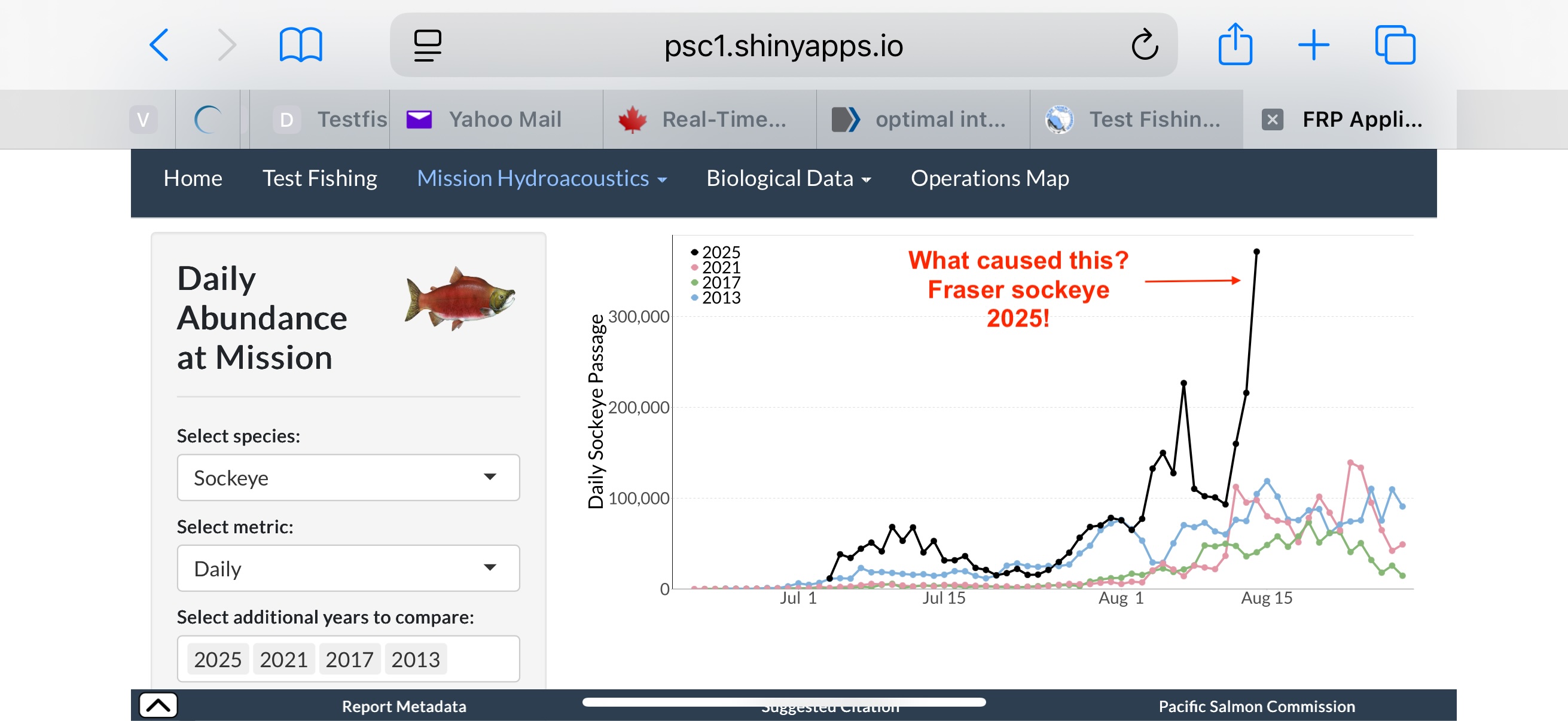
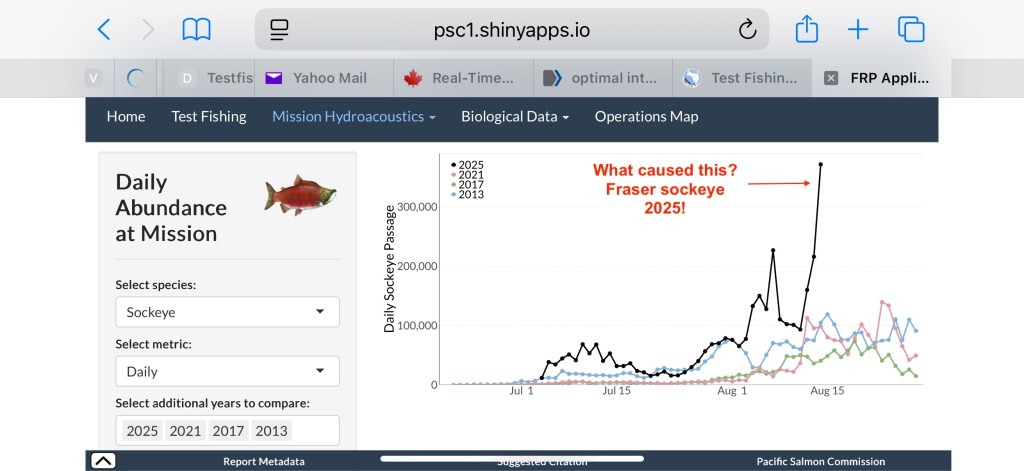
A large portion of his letter was in response to my question – have you been fully briefed on the unexpectedly high 2025 Fraser sockeye survival?
The previous Liberal government policy to close salmon farms was based on recommendations from the 2010 $28 million federal Cohen Inquiry into the 18-year Fraser sockeye collapse. As a result, starting in 2021 young sockeye were not exposed to farm salmon pathogens for the first time since1992. Every generation since has reversed the decline returning in numbers higher than their parental generation. Other BC sockeye runs have not done this. It appears the policy was successful, achieving the goal of the Cohen inquiry to restore Fraser sockeye.
I didn’t ask for his opinion, but Neil chose to float a his ideas on why these sockeye are rebounding. He omitted all the evidence regarding salmon farms:
Hatcheries – If you think hatcheries were responsible, it is important to state the change/s that occurred in all Fraser sockeye hatcheries in 2021 across the early, summer and late runs. If nothing changed, hatcheries were not responsible. This should be easy to report on.
Big Bar landslide – Neil stated “this large return would not have occurred” without the work to restore salmon passage past Big Bar. Clearly, this was very important, but not to the Late Run sockeye which at least tripled the forecast, and don’t migrate past Big Bar.
Fisheries management – is important, but DFO managers testified at the Cohen how they met target Fraser sockeye escapements every year by cutting back on fishing. If fishing was the primary driver of the decline, Fraser sockeye would have rebounded when fishing was reduced but they didn’t. That suggests something else was killing them.
Minister, it’s a fact. Every generation of Fraser sockeye that has gone to sea without exposure to farm salmon pathogens in the Discovery islands has reversed their 30 decline in survival.
In a world suffering catastrophic biodiversity collapse, what has happened here is remarkable. Rivers filled with salmon, fisheries were opened, Fraser First Nations harvested food fish they have gone without for a long time. The northern resident orca re-established historic use of the Johnstone Strait area. Wildlife tourism flourished. BC forests received open-derived nutrients. People, over-joyed, spread pictures on social media of wild salmon in long empty rivers.
DFO houses one of the world’s most advanced scientific fisheries teams in the world. They are pioneering unprecedented methods of evaluating what is going on with salmon providing higher quality information than ever previously possible. Their intensive work examining the immune systems of salmon travelling along the BC coast reports infection and reduced survival of young salmon swimming through the effluent of the industrial salmon farms (see below). There are several increasingly interesting papers on this that will be published soon.
Therefore, I don’t understand why a bureaucrat was tasked to freewheel sound bites about something so important as why salmon are suddenly returning when DFO has so much high quality information?
I respectfully ask, please, use your molecular genetics lab working in collaboration with the Pacific Salmon Foundation on salmon health to provide real information on what these sockeye can tell us about their remarkable journey back towards abundance despite fires, drought, ocean warming, etc.
We have been given a second chance. Something is allowing salmon in BC to thrive again. Likely it is fragile given the state of our planet and you are in the position to ensure it continues or not. I have received DFO letters like Neil’s for 35 years. But now that we are witness to what happens when salmon farms are removed, the stakes for your government are much higher.
Ultimately you are weighing the risk whether reinstating salmon farms is going to undo the benefits of this Liberal Government policy and send Fraser sockeye back towards extinction. People are watching this carefully. In this report I compile DFO data on salmon returns vs salmon farms. At the very least these observations are worthy of a better-considered response based on real information on the state of immune system of salmon that have now been provided relief from exposure to the pathogen levels shed by farmed Atlantic salmon in open net pens.
Thank you to you and your government for your efforts in these very difficult times.
Alexandra Morton
Independent Biologist
Some of the Peer-Reviewed Papers documenting impact of farm salmon disease on wild salmon
In seawater, T. maritimum environmental-DNA is almost exclusively detected next to active salmon
farms sites (vs inactive sites) and shows one of the strongest associations with salmon farm operations among infectious agents studied.
T. maritimum is the most notable infectious agent present in dead and dying fish on BC salmon farms throughout the production cycle.
Tenacibaculum maritimum is associated with decreased survival in Chinook salmon and decreased body condition (“plumpness”) in coho and Chinook along the BC coast.
Detection of Tenacibaculum maritimum in wild Fraser River sockeye salmon is strongly associated with salmon farms in the Discovery Islands, along their migration route northward. Evidence suggests that 6 to 56% of sockeye smolts may die as a result of farm-origin T. maritimum exposure. Farm-origin exposure peaked in the Discovery Islands with an approximately 13-fold increase as compared to background levels.
This clinical report represents the first diagnosed case of tenacibaculosis in wild-caught (captive)
Chinook salmon in British Columbia, and highlights the possible role of Tenacibaculum species other
than T. maritimum in the risks posed by salmon farms to wild salmon in BC. The report identifies
Tenacibaculum dicentrarchi as the probable cause of clinical disease and substantial mortality of captive wild Chinook
First detection of PRV in the Pacific region. PRV detections were associated with jaundice/ anemia
outbreaks on Chinook farms.
Early phylogenetic analyses of PRV sequences generated from samples in BC and Chile concludes PRV in BC and Chile are both descendants of PRV from Norway.
Occurrence of PRV in wild pacific salmon around BC is correlated to exposure to salmon farms. PRV was detected in almost all Atlantic salmon (~95%) and in 37-45% of wild salmon in regions highly exposed to farms. PRV proportion was also lower following a migration event, indicating a selection of PRV on completing migration and thus reproductive capacity as well as fitness.
Heart and skeletal muscle inflammation (HSMI) diagnosed in BC farmed salmon, with PRV linked to the occurrence, severity, and timing of the diseased heart tissue.
PRV is tightly associated with “jaundice/anemia” in farmed Chinook salmon.
PRV prevalence on farms in BC is such that it infects nearly all farmed Atlantic salmon at some point in the production cycle.
PRV prevalence is close to ubiquitous in escaped farmed Atlantic salmon following a large containment failure at a farm in northern Puget Sound. Icelandic salmon were used to stock Atlantic aquaculture sites in Washington State. The lineage of PRV detected in the escaped fish was similar to an Icelandic PRV sequence.
Phylogeographic analyses found that PRV’s first introduction to BC from Europe coincided with the
advent of Atlantic salmon farming in the region. Molecular surveillance and viral genome sequencing
concluded that resident wild Chinook salmon are more likely to be infected with PRV the closer they are to salmon farms, and that PRV regularly transmits between farmed and wild salmon.
PRV is associated with decreased survival in Chinook salmon and decreased body condition
(“plumpness”) in both coho and Chinook.
Novel viruses discovered in dead and dying farmed salmon that are widespread in farmed, hatchery and wild Pacific salmon.
Novel or previously undiscovered viruses revealed in dead and dying farmed Atlantic and Chinook in
British Columbia. Atlantic salmon calicivirus and Cutthroat trout virus-2 were in more than half of the
farmed Atlantic salmon tested. Some of the viruses first discovered in farmed Atlantic salmon were in Chinook salmon, suggesting a broad host range.
Global expansion of aquaculture and agriculture facilitates disease emergence and catalyzes transmission to sympatric wildlife populations.
First Nation led research on eDNA samples collected from seven active and four inactive netpen aquaculture sites in the Broughton Archipelago shows infectious agents were significantly higher near active salmon farms.
DFO’s “Disease Agent Assessment form” concludes that T. maritimum is not “likely to cause disease… in wild fish populations” and that Piscine orthoreovirus is not an “infectious disease agent”, despite reliable evidence suggesting the opposite and this form is used to permit transfer licences for farm salmon into wild salmon habitat.