Hello
It is time to talk to the people behind salmon farming – the consumer.
As you know I have worked very hard for 25 years to inspire the salmon farming industry to grow up and clean up, but the science, the law and our activism together has not been enough. The Cohen Commission, Canada's $26 million federal inquiry, made fair and far-reaching recommendations to protect wild salmon from salmon farming, but they are being ignored by the very people who called the inquiry. In January as Marine Harvest rang the opening bell at the New York Stock Exchange the Harper government threw open the doors to farmed salmon expansion in BC.
And finally, this week Mexico and Canada voted together to prevent an inquiry recommended by a NAFTA commission directly into Canada's record on protecting wild salmon from salmon farms.
Meanwhile in Norway, there has been growing controversy about the health risks of eating farmed salmon. The US #1 business news outlet echoed Norway's health concerns Bloomberg on farmed salmon.
Canada is changing its laws to allow this industry to own salmon in the ocean, release chemicals that kill fish and permit destruction of wild salmon to protect farmed salmon from disease. The tail is wagging the dog with far-reaching implications to people, whales, climate and our future.
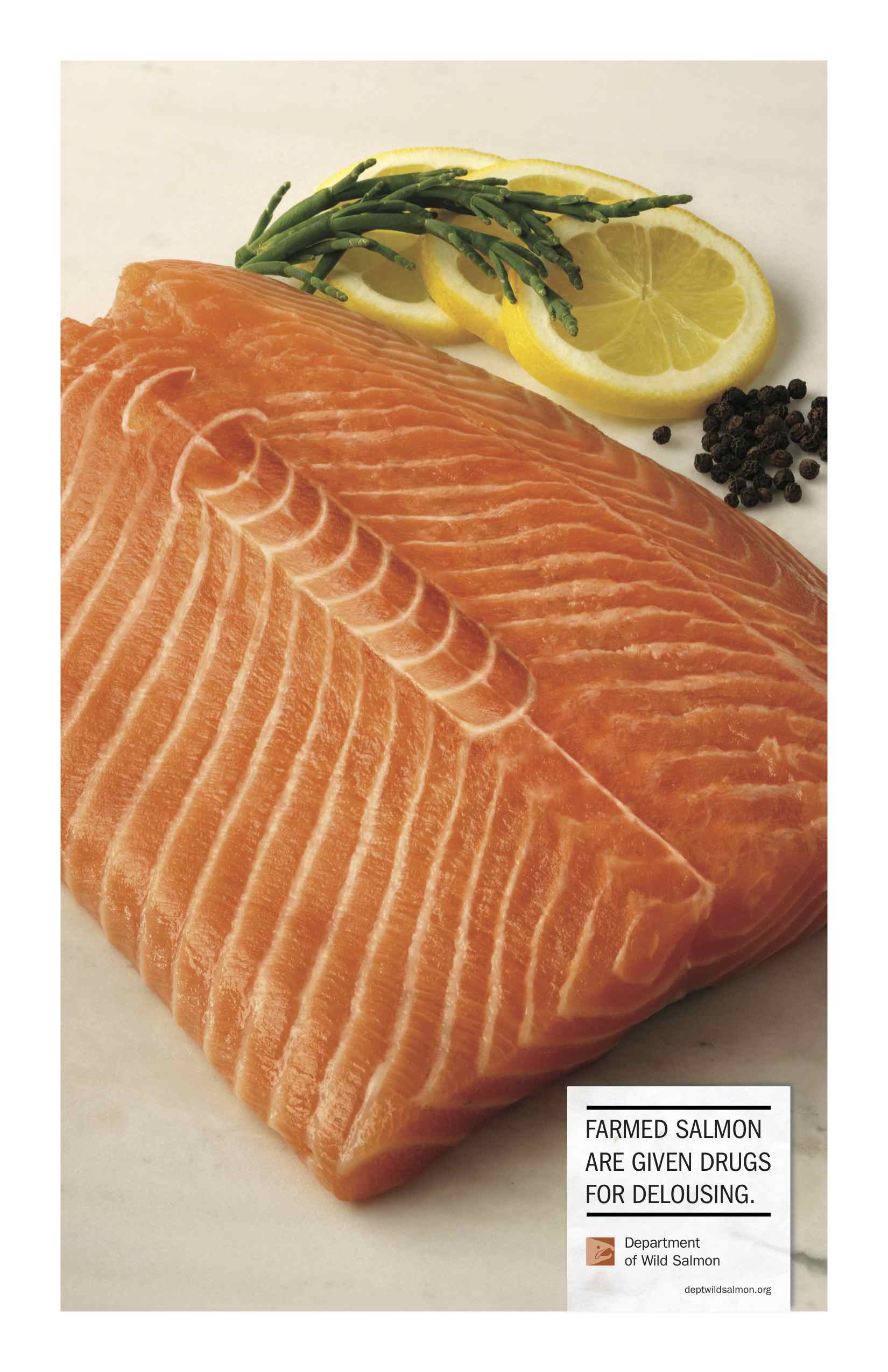
It is time to tell the consumer about farmed salmon and step one is the ad pictured below. I have raised $50,000 in matching funds if another $150,000 can be raised to place this ad where it will be seen by thousands of people behind farmed salmon in BC – the consumers.
It is time. This is something that has not been tried. You can donate here, no matter how small.
We STILL have not received a decision from the courts on whether salmon farmers can transfer diseased fish into sea pens among the wild salmon. I will let you know as soon as I know. Thank you all for sticking with me on this for so many years.
Comments
5 responses to “It is time to talk to the people behind salmon farming”
I think more emphasis should be placed on the toxins in those big white lines of fat–toxins at levels ‘greater than reported in any other food including meats, poultry, and dairy products…contaminants such as dioxins & DLCs (Dioxin-Like Compounds) associated with poor brain development, autism, ADHD, etc’ (http://www.ncbi.nlm.nih.gov/pmc/articles/PMC1257546/) –despite a comment i read somewhere: ‘For the most part, most people don’t care that much, they just want a nice well served salmon roll at the sushi joint. Better it be raised on land and not affecting wild stocks is what I am getting at. You might care but many people don’t’.
With all respect, Alexandra, I’m afraid the text accompanying that picture could send the wrong message, i.e., that all salmon have lice, but only farmed salmon are treated for them—the suggestion being that farmed salmon are actually safer. I also think the graphic element is too subtle to outweigh the ambiguous text: The hypodermic syringe was not the first thing to jump out at me. Of course, like those 3D images, once you see it, you can’t “unsee” it, but casual viewers may not see it at all. I’d leave lice out of the equation and focus the message on the fact that farmed salmon are heavily treated with drugs, period.
Thank you Jean for your feedback I will certainly give it thought. I think it is fair to say that the industry may consider legal means to prevent discussion of farmed salmon, so that is something I also weigh carefully.
I agree with you that the issue of toxins in farmed salmon needs to reach North Americans. It certainly caused a political stir in Norway, and impacted the markets in France and Russia.
I am SO with you, Alexandra.
I do think the ad needs to be less subtle, however.
Donating!