Our discovery of the salmon heart virus, piscine reovirus (PRV) which causes Heart and Skeletal Muscle Inflammation (HSMI) has been reported on in the press. The quotes provided from the province, DFO and the industry are conflicting and hint at internal chaos and gears grinding.
Mary Ellen Walling-Director BC Salmon Farmers
“We are not seeing any indication of a virus with the impacts that she has described in the release” FIS
“In B.C., the government fish health lab assesses heart muscles routinely for indications of disease and has not found any consistency between these tissues and the presence of this virus.” Times Colonist
Dr. Gary Marty – B.C. government fish health lab
“In 2010 the province found PRV was common in farmed Atlantic salmon, but infection was not related to disease“
“If the fish were infected with a deadly virus, they would not have survived to be harvested or sold” Times Colonist
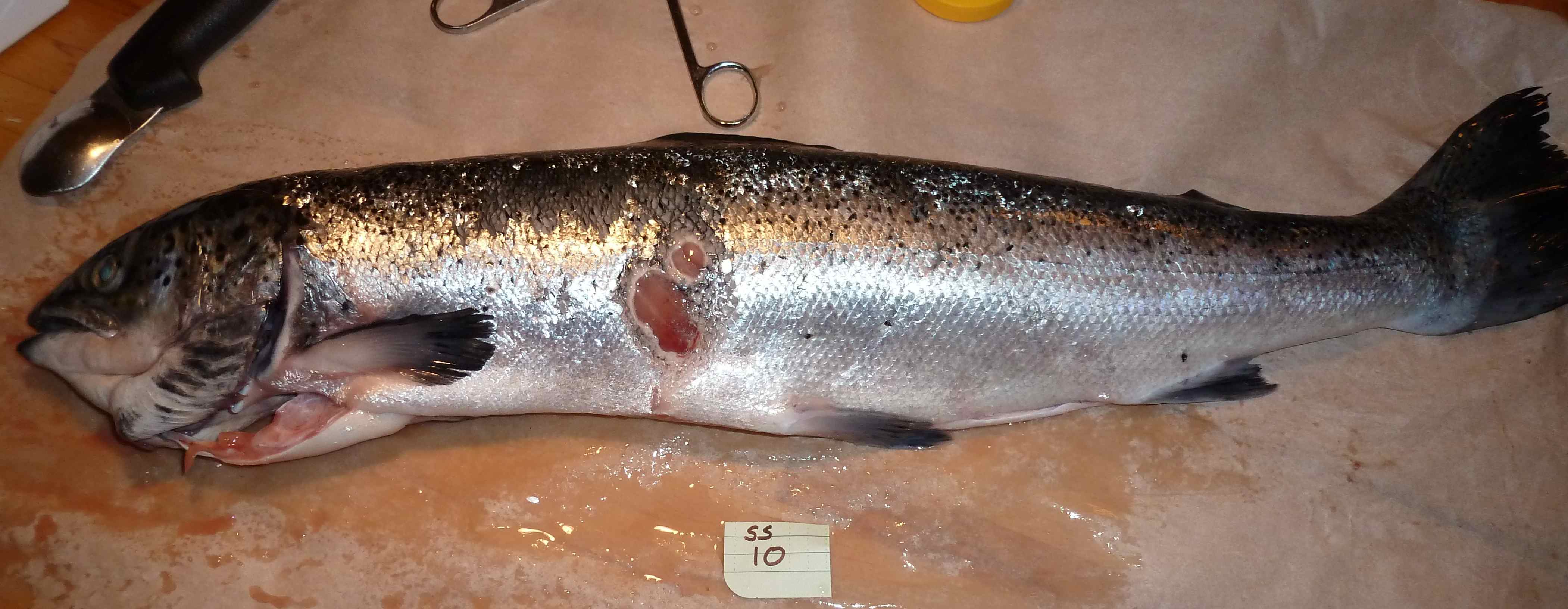
A farm salmon with Piscine reovirus from Superstore weighed 1.6 kg gutted. Normal harvest-size is 4.6 – 6 kg, the sores are unidentified
DFO – Frank Stanek, media relations
“Government of Canada scientists have not confirmed the presence of this virus in Canadian fish, despite extensive monitoring and testing.”
Government of Canada Scientist testimony Cohen Dec. 15, 2011 Page 113
Q. Did you find piscine reovirus
Dr. Miller. We did find fish positive for the piscine reovirus, which is thought to be causing HSMI.
Dr. Miller … we see piscine reovirus in our wild migrating sockeye salmon.
______________________________________________________________________________________
How could the BC Salmon Farmers say they have not seen any indication of the impacts of this virus, when the provincial vet auditing their fish said it was “common”? In 2010, the virus had not been identified, the disease was known only by its “impact” on the fish. In his records made public by the Cohen Commission, there is 1 record of HSMI in Mainstream’s fish in 2008 and in 2010 he repeatedly mentions a “distinctive lesion” in the hearts of farm salmon.
“Congestion and Hemorrhage in the stratum compactum of the heart (i.e., the peripheral layer of dense cardiac muscle) is a distinctive lesion that I started seeing in 2008 in clinical submissions both from Atlantic and Pacific salmon. I noted this change only once among samples examined from 2006-2008 as part of the BCV audit and Surveillance Program, but in 2009 I had several cases. Clinical cases included all Marine Harvest cases that ask had renal intratubular hemorrhage (i.e., those cases listed above).“
Walling and Marty’s statements do not agree, she says they have not seen the impacts of HSMI, Marty reports the impact of HSMI on the hearts of Atlantic salmon belonging to Mainstream and Marine Harvest, which use fish from stock that were imported into BC as eggs. No one screened these eggs for piscine reovirus, because no one knew the virus existed until 2011.
The DFO spokesperson and the DFO scientist’s statements also do not agree.
Here is what scientists from a World Health Organization-sponsored lab have to say:

The identity of a mysterious disease that’s raged through European salmon farms, wasting the hearts and muscles of infected fish, has been revealed.
Genome sleuthing shows the disease is caused by a previously unknown virus. The identification doesn’t suggest an obvious cure — for now, scientists have only a name and a genome — but it’s an important first step.
“It’s a new virus. And with this information now in hand, we can make vaccines,” said Ian Lipkin, director of Columbia University’s Center for Infection and Immunity, a World Health Organization-sponsored disease detective lab.
Two years ago, Norweigan fisheries scientists approached Lipkin and asked for help in identifying the cause of Heart and Skeletal Muscle Inflammation, or HSMI, the official name for a disease first identified in 1999 on a Norweigan salmon farm.
Infected fish are physically stunted, and their muscles are so weakened that they have trouble swimming or even pumping blood. The disease is often fatal, and the original outbreak has been followed by 417 others in Norway and the United Kingdom. Every year there’s more of the disease, and it’s now been seen in wild fish, suggesting that farm escapees are infecting already-dwindling wild stocks.
Lipkin’s team — which has also identified mystery viruses killing Great Apes in the Ivory Coast, and sea lions off the U.S. West Coast — combed through genetic material sampled from infection salmon pens, looking for DNA sequences resembling what’s seen in other viruses, and inferring from those what the HSMI-causing sequence should look like. Lipkin likened the process to solving a crossword puzzle. The researchers eventually arrived at the 10-gene virus they called piscine reovirus, or PRV. The virus was described July 9 in Public Library of Science One.
Related reoviruses have been found on poultry farms and cause muscle and heart disease in chickens. “Analogies between commercial poultry production and Atlantic salmon aquaculture may be informative,” wrote the researchers. “Both poultry production and aquaculture confine animals at high density in conditions that are conducive to transmission of infectious agents.”
Such findings may be useful as the Obama administration develops a national policy for regulating aquaculture.
“If the potential hosts are in close proximity, it goes through them like wildfire,” said Lipkin.
Image: A healthy salmon, above; a salmon with HSMI, below./T. Poppe.
Comments
One response to “For the Record”
The reactions to the comments by Ms. Morton (on piscine reovirus and heart and skeletal muscle inflammation in farmed salmon) by the farmed fish industry and the industry regulators are very defensive.
And very short sighted.
Perhaps if the industry and regulators were current with recent Norwegian research, they might not be so sanguine.
In a recent study, posted April 9, 2012, Norwegian researchers, funded by the Research Council of Norway, confirmed the association between PRV( piscine reovirus) and HSMI (heart and skeletal muscle inflammation). The researchers went on to state that their results strengthened the hypothesis that PRV is the causative agent of HSMI.
The article is: Immunohistochemical detection of piscine reovirus (PRV) in hearts of Atlantic salmon coincide with the course of heart and skeletal muscle inflammation (HSMI); Veterinary Research 2012, 43:27 Oystein W Finstad et al.
The results are not what the farmed fish industry in B.C.are claiming.
To be fair, the Norwegian researchers point out that PRV is widespread in Atlantic salmon marine farms and that detection of PRV by itself does not establish a diagnosis of HSMI. On the other hand, the same researchers identify that single species, high density stocking in salmon farms favours transmission of infectious agents and viruses.
In light of this data, it might be prudent for the farmed fish industry to ensure that fish farms and wild salmon migration routes are widely separated, for the ecological and economic health of both sectors.
-30-