The operation of eighteen salmon farm sites in the Discovery Islands region is under review through DFO consultation with 7 Nations that have overlapping territories in the Discovery Islands; Kwiakah, We Wai Kai, We Wai Kum (Laich-kwil-tach Nations) and Komox, Homalco, Klahoose, and Tla’amin. All the federal licences of these farms which are owned by Mowi, Cermaq and Grieg expire on December 18, 2020. DFO has to consult with the nations whose territories are being used by these companies.
The following farms are under review. Farms in grey are sites that have been inactive for ~ 5 years or longer. Each farm holds 600,000 – 1,000,000 Atlantic salmon, except for Yellow Island and Doctor Bay, size unknown, species Chinook and possibly Coho.
121059 Phillips Arm, Mowi
121058 Brent Island, Okisollo Channel, Cermaq
121057 Raza Island, Raza Passage, Cermaq
121056 Dunsterville Bay, Hoskyn Channel
121055 Sonora Island, Okisollo Channel, Mowi
121054 Bickley Bay, East Thurlow Island
121053 Thurlow Point South, Nodales Channel
121052 Brougham Point, East Thurlow Island
121051 Read Island, Bear Bay
121050 Cyrus Rocks, Okisollo Channel
121049 Young Passage, Sonora Island
121047 Doctor Bay, West Redonda Island, 622335 British Columbia Ltd.
121046 Yellow Island, Discovery Passage, Yellow Island Aquaculture (1994) Ltd.
121045 Barnes Bay, Sonora Island, Grieg
121044 Sonora Pt., Nodales Channel, Mowi
121043 Venture Point, Sonora Island, Cermaq
121042 Chancellor Channel, West Thurlow Island, Mowi
121041 Lees Bay, N. Shore, West Thurlow Island, Mowi
The area under consultation is roughly DFO Management Area 13, however, three salmon farms on Johnstone Strait, yellow dots (Map 1), were omitted from the consultation because DFO appears to be using its Fish Health Surveillance zone- 3-2.
 Farm names, including 2 farms that appear to have had their licences cancelled, Farside and Egerton Creek, because they are not included in the consultations.
In terms of impact on migrating wild salmon, there is no biological reason to omit Shaw, Althorpe and Hardwicke. The majority of the farms in the Discovery Islands are owned by Mowi, Norwegian-based, largest salmon farming company in the world. Next is Cermaq, Norwegian – based company owned by Mitsubishi. One site is owned by Grieg Seafood, a Norwegian family engaged primarily in shipping. As well, there are two single farm companies that raise Pacific salmon presenting a different set of risks, i.e. switching to Pacific salmon is not a solution as genetic pollution becomes a serious problem, as Norway knows.
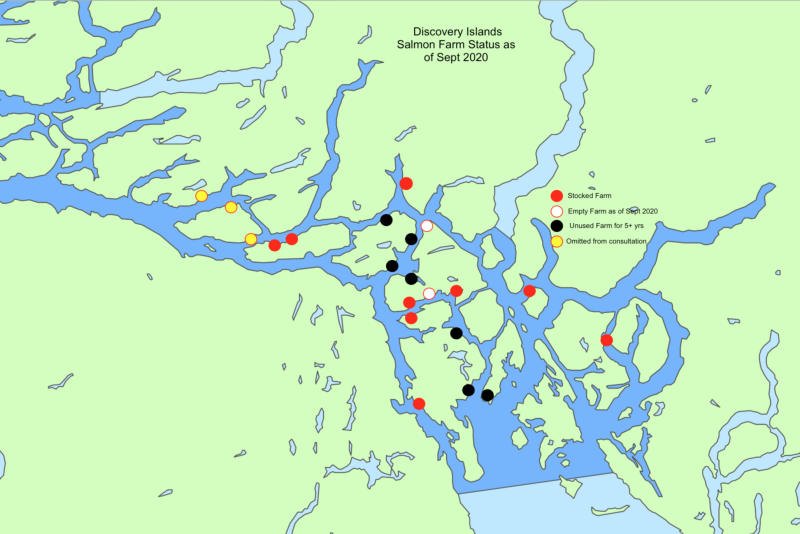 The 18 farms included in the consultation include 7 farms that have been inactive for ~ 5 years or more (black), 8 active farms (red). The 2 most southern farms are smaller farms. The primary impact on Fraser salmon is the 6 active Atlantic salmon farms.
Most of the sites are currently reporting over the 3 motile lice limit that was set by the Province of BC 15 years ago, as safe for wild salmon. This limit is only in effect March – June, which DFO considers the juvenile wild salmon outmigration time period, although in reality, the migration period is much longer, extending into September in some regions and some Coho and Chinook remain in coastal waters over the winter. Fraser sockeye appear to migrate the fastest and pass through the Discovery Islands from late May – June. However, high lice numbers now mean that the industry has a lot of work to do coast wide to get their lice under control before March. The federal government removed the incentive for the industry to reduce its impact on wild salmon by granting them unlimited lice numbers for 42 days every spring as the last of BC's young wild salmon struggle to get to sea through fish farm clusters throughout southern BC.
Broughton Archipelago
Of note, in the Broughton Archipelago, where First Nations have taken over the authority of removing and managing salmon farms from DFO, none of the farms have been over the 3 motile lice limit for this entire year. Broughton Nations have taken a much stricter approach to sea lice than DFO in hopes of protecting their highly damaged wild salmon returns during the last few years that they are allowing these farms to operate in their territories. While DFO is allowing the salmon farming industry to have an unlimited number of lice for 6 weeks during the juvenile salmon outmigrations in other territories, Broughton Nations do not allow this and industry has complied. It is likely that the salmon farming industry does not have enough boats to delouse all their farms and perhaps the industry is prioritizing stricter delousing in regions where they are concerned that First Nations will order their removal. 60% of juvenile salmon leaving Broughton Rivers were completely uninfected with sea lice, whereas 99% of juvenile sockeye that swam through the DI last spring were infected at levels we know will reduce their survival.
Options to protect the 2021 juvenile salmon out-migration from farm lice
The area of greatest impact on the 2021 juvenile salmon is Okisollo Channel. This is because it is a small area that young Pacific salmon aggregate in and three different companies operate 4 farms there. The smaller the area, the less dilution of the waste that is coming out of these farms and so the bigger the dose of bacteria, viruses and sea lice. Salmon farms are super-shedders and their impact is greatest in confined waters like the narrow, short Okisollo Channel. It is the difference between standing a football field away from a COVID positive person and sitting in a small room with the same infected person.
When my team and I sample for sea lice research, we always find a lot of young wild fish in Okisollo. It is part of their natural migration route and there is nothing we can do to keep them out of there. While all the Discovery Island farms are exposing young wild salmon to unnatural pathogen loads, Okisollo is the worst due to the number of farms, how confined an area it is and how many young wild salmon congregate there. We can't move the wild salmon, but we can move the salmon farms to stop the dangerous spread of industrial infections into wild populations.
 Young sockeye migrating past salmon farm in Okisollo Channel, pass through the industrial biological waste from this operation.
Protective measures
- Removing the 5 farms that have been inactive for years will sound good, but will do nothing to protect wild salmon.
- Best option – remove all salmon farms from the Discovery Islands by March 1, 2021. This would give the extremely weak Fraser sockeye salmon the best chance of getting to sea
- Second best remove all farms from Okisollo Channel by March 1, 2020 and apply the measures below to all remaining sites:
-
- Remove the 42-day unlimited lice condition of Licence 7(c) granted on March 1, 2020 in the DFO Conditions of Licence March 1 Aquaculture This condition is a strong signal of "regulatory capture" meaning that while this keeps the salmon farming industry "in compliance" with their conditions of licence, it kills wild salmon. This is DFO at its worst.
- Remove the 42-day unlimited lice condition of Licence 7(c) granted on March 1, 2020 in the DFO Conditions of Licence March 1 Aquaculture This condition is a strong signal of "regulatory capture" meaning that while this keeps the salmon farming industry "in compliance" with their conditions of licence, it kills wild salmon. This is DFO at its worst.
-
- Require weekly sea lice counts that include all lice life stages, not just “motile” (adult) stages so that we can see lice numbers building before they reach adult stages and begin reproducing and killing young salmon, and if the juvenile stage lice start escalating out of control – cull, not harvest the farm before the lice reach adult stages and start releasing larval lice into BC's biggest wild salmon migration route.
- Require weekly sea lice counts that include all lice life stages, not just “motile” (adult) stages so that we can see lice numbers building before they reach adult stages and begin reproducing and killing young salmon, and if the juvenile stage lice start escalating out of control – cull, not harvest the farm before the lice reach adult stages and start releasing larval lice into BC's biggest wild salmon migration route.
-
- DFO and First Nation joint oversight of industry lice counts, because recent published scientific paper reports that if we let industry count sea lice on their own, they under count the lice by up to 50%, which delays treatment and kills wild salmon.
- DFO and First Nation joint oversight of industry lice counts, because recent published scientific paper reports that if we let industry count sea lice on their own, they under count the lice by up to 50%, which delays treatment and kills wild salmon.
-
- Agree on a lice limit that considers not only how many lice per farm salmon, but also how many farms are in the entire area. The more farm salmon, the lower the lice limit per fish. So if there is 1 farm in a region or 4 farms in a region the total lice in the water has to be the same, i.e. if there are 4 farms there needs to 1/4 the allowable lice on each farm, than if there was only 1 farm in the region.
- Agree on a lice limit that considers not only how many lice per farm salmon, but also how many farms are in the entire area. The more farm salmon, the lower the lice limit per fish. So if there is 1 farm in a region or 4 farms in a region the total lice in the water has to be the same, i.e. if there are 4 farms there needs to 1/4 the allowable lice on each farm, than if there was only 1 farm in the region.
-
- As soon as any farm goes over the limit, the entire farm must be culled (not harvested as that takes weeks)
-
- Prohibit wellboat delousing from releasing any effluent into the Discovery Islands during the spring out-migration. This is going to require third party monitoring as industry is saying different things about these boats 1.) that they cannot catch all their lice (Nov 1, 2019, DFO Fish Health Meeting) 2.) that they do catch all the lice coming off farm salmon during treatments (various presentations to First nations). So we won't know which is the truth unless we look for ourselves.
- Research earlier this year off Port hardy found an average of 42 newly hatched sea lice on young sockeye salmon near the Mowi delousing vessel Aqua Tromoy during sea lice treatments. As this is 4 times higher than ever seen before in 20 years of sea lice research in BC, precautionary measures have to include restricting operation of these well boats.
- Prohibit wellboat delousing from releasing any effluent into the Discovery Islands during the spring out-migration. This is going to require third party monitoring as industry is saying different things about these boats 1.) that they cannot catch all their lice (Nov 1, 2019, DFO Fish Health Meeting) 2.) that they do catch all the lice coming off farm salmon during treatments (various presentations to First nations). So we won't know which is the truth unless we look for ourselves.
I have the greatest respect for the seven First Nations who are in consultation with DFO over the future of wild salmon on the coast of BC.