I went back to Port Elizabeth on October 16 to observe the Viktoria Viking offloading young farm salmon again. The staff on the farm blocked my view of the fish pouring into the pens, so this time I stepped on the farm to take a good look at the condition of the fish.
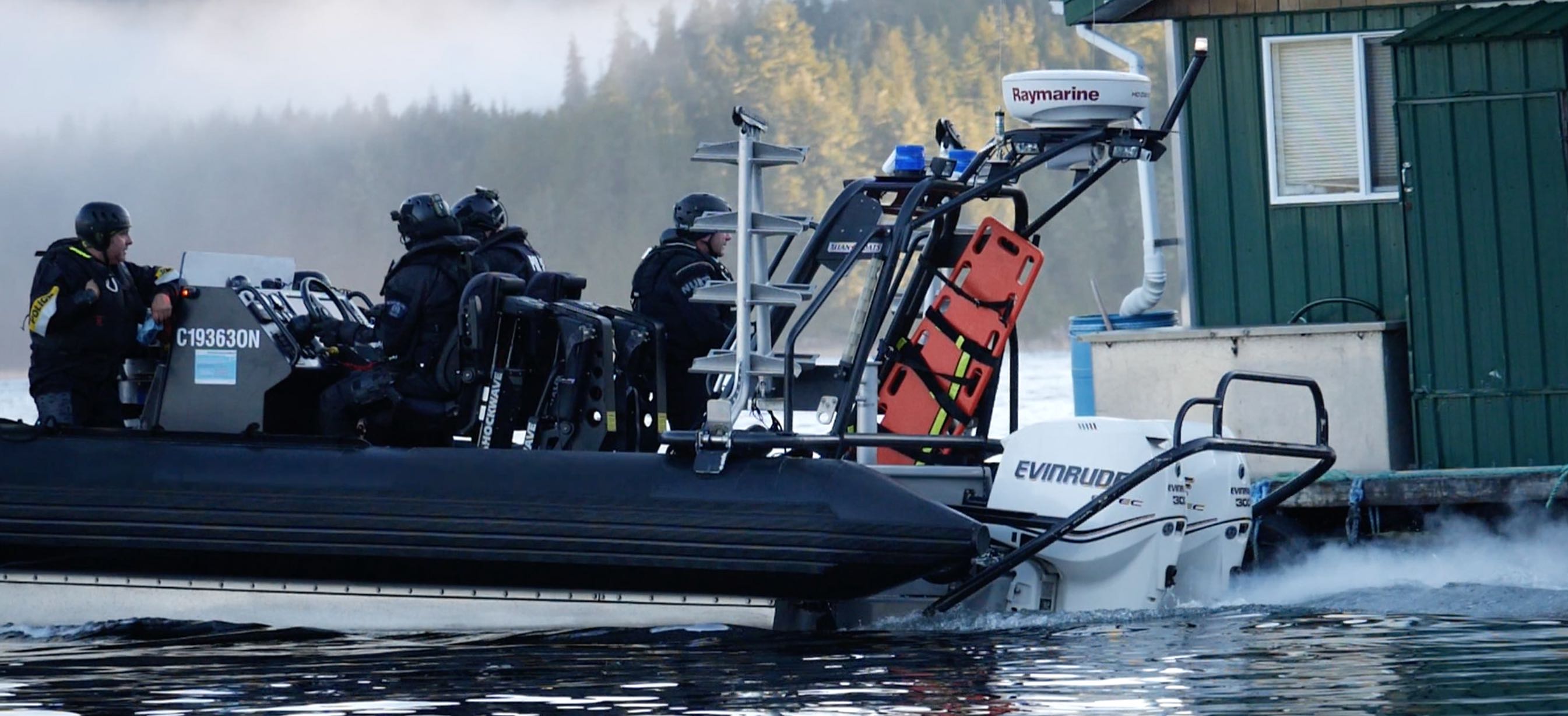

The RCMP presence was heavy, two boats with 7-8 officers each in tactical gear. A police team was clustered protectively around the pipe, it seemed they expected me to do something to the pipe… what, really, with my bare hands? I watched ~200,000 young Atlantic salmon poured out of the boat into the pen in Knight Inlet. Every time I see this I think lethal injection. When Marine Harvest petitioned the court to join the Minister of Fisheries, LeBlanc, as a defendant in my lawsuit to make DFO test farm salmon for piscine reovirus, before they enter marine waters, Marine Harvest revealed that 5 out of 6 of their hatcheries is infected with piscine reovirus. Marine Harvest said they would be "severely impacted" if they couldn't put these infected fish in their pens. These fish were from Ocean Falls. Is this one of Marine Harvest's infected hatcheries?
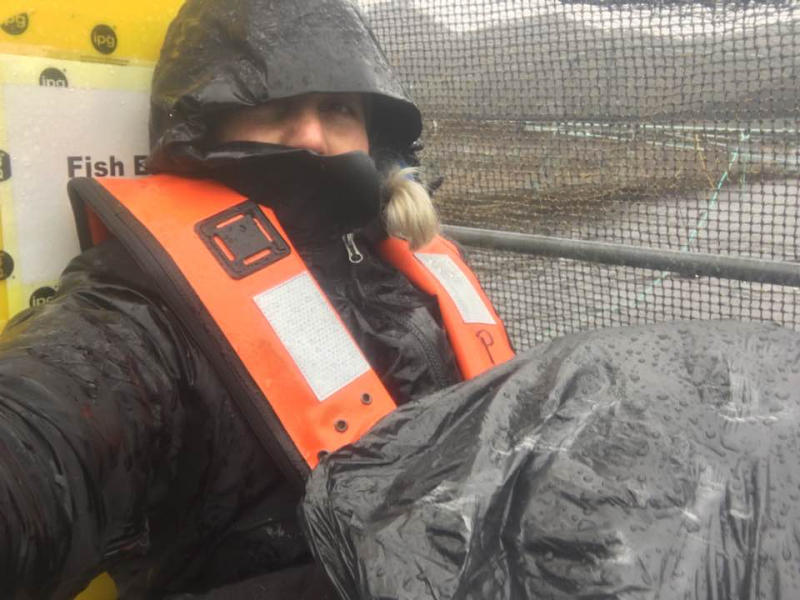
When the transfer was completed, the RCMP and the Viking left. I was alone with the fish and the workers. The security guard, clearly out of his element begged me to call a boat and leave so he wouldn't have to stay out in the cold Knight Inlet rain and wind, but I refused. I am used to this weather and when it began to rain I cosied up to the bedding in the garbage bag I had with me. Craig pulled up a chair and watched me wait out the squall. I felt a bit sorry for him and suggested he could watch me from inside their office on the security cameras, which I think he did as he left shortly after.
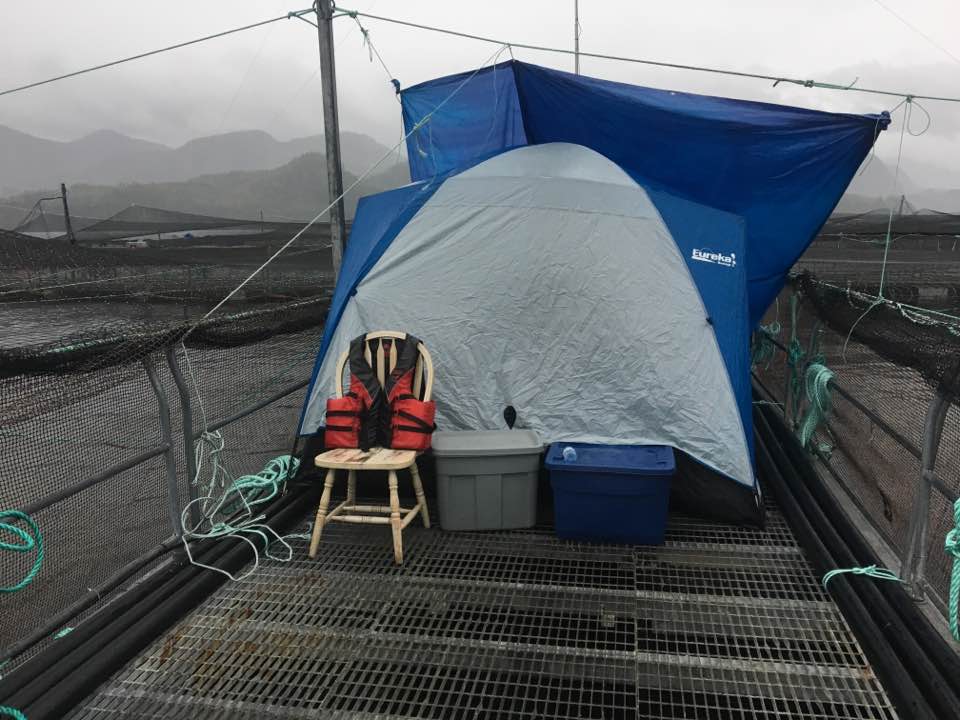
 Shortly after dark several people joined me on the farm, we set up a tent. I was prepared to be alone, but was grateful for their company.
Each pen had several very brilliant lights and this allowed me to look deep into the pens. Hundreds of fish were lined up resting against the nets. Small herring streaked over the lights, like moths to the flame. Bright lights have been banned from the commercial fishing industry for decades because too many fish were attracted to the nets and killed. Today, the lights on salmon farms appear to be working their same dangerous magic, drawing the endangered Musgamagw territory herring into captivity. I still don't know what their fate is once they get into the pens. I documented Cermaq holding onto thousands of herring over a month after harvesting-out the Atlantic salmon. I don't know what happened to them, but I doubt they were released. We know some wild fish in the pens are eaten by the farm salmon, but I am guessing herring exposed to farm salmon are too big a disease risk to be released. What these companies do with these fish amounts to an unregulated fishery on a highly valuable and endangered stock. Commercial fishing of these stocks has been closed for 30 years and still the fish have not recovered their once abundant levels. I think salmon farms are preventing the return of the Kingcome Inlet herring stock.
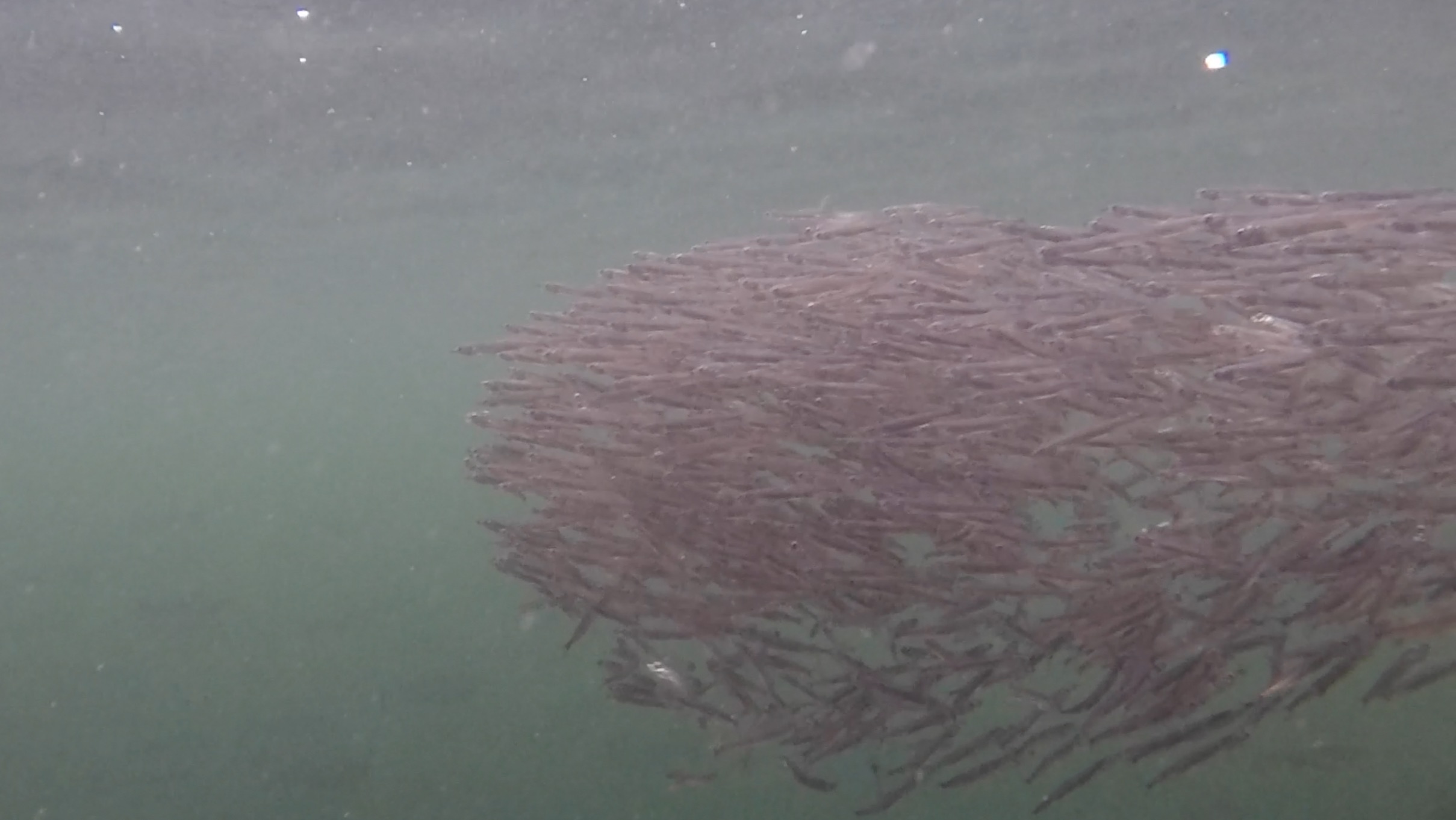
We fell asleep to the splashes of the captive fish and occasional soft breath of a young seal that had found his way between the outer predator nets and the nets that actually contained the fish. I hoped he found his way out alive.
The next day was a wet one, but I continued to examine the fish fresh from the Ocean Falls hatchery, Heiltsuk territory. So many had open sores, there were larval species other than herring and many fish were suffering from something that blew them up like balloons, they were dying rapidly. I thought about the viruses and bacteria potentially associated with the condition of these fish pouring into Knight Inlet and out into beautiful Blackfish Sound.
In the early evening, security guard led a procession of farm workers and handed us piles of paper rapidly wilting in the rain… an application by Marine Harvest for an injunction against us and John and Jane Doe. It was Monday night, the hearing date was on Wednesday in Vancouver.
This document told us a lot about the transfer operations.
- The smolts weigh 140 g on delivery,
- each one cost Marine Harvest $3 to raise for the past year in a tank and it will take 18-21 months in seawater for them to grow to harvest size
- Marine Harvest planned to put 1.8 million smolts in this farm, Port Elizabeth.
- Most importantly they explain that once they trigger the smoltification process in the young salmon, i.e. preparing them for saltwater transition they had about 1 week to transfer them from the hatchery into the farm.
That night the tent was buffeted by gales from the west and then from the southeast.
I was a pile of wet wool, I slept in my boots, but was buoyed by the bravery of the three other women with me in this storm. The fabric of the tent hit us repeatedly as it collapsed in the wind and then popped back up. I held the tent off with one hand as I read the details of Marine Harvest's complaint against us. The papers were served on Monday, and the court hearing would be in Vancouver on Wednesday. However, in their haste, every other page was missing, the judge had signed the wrong date and exhibits described were not attached. While the court might have overlooked all this, Marine Harvest strangely withdrew the application on the morning of the hearing. This is the second time Marine Harvest has backed away from First Nations in this fight.
We were awoken before dawn by bright lights as the fish farm packer Orca Chief pulled up to the farm and we headed out to witness their activities. Magically RCMP swarmed in around us in the dark storm. We got there first and so had a front row view of the transfer of farmed Atlantic salmon. These fish were from the Dalrymple Hatchery owned by Marine Harvest. This hatchery is ground zero in my lawsuit to make the Minister of Fisheries uphold the laws of this land as per section 56 of the Fisheries General Regulations and test all farm salmon for piscine reovirus before issuing a permit for them to be transferred into marine pens, because those who wrote our regulations prohibited transfer of fish carrying a disease-agent. We learned that the Dalrymple Hatchery was one of Marine Harvest's infected hatcheries.
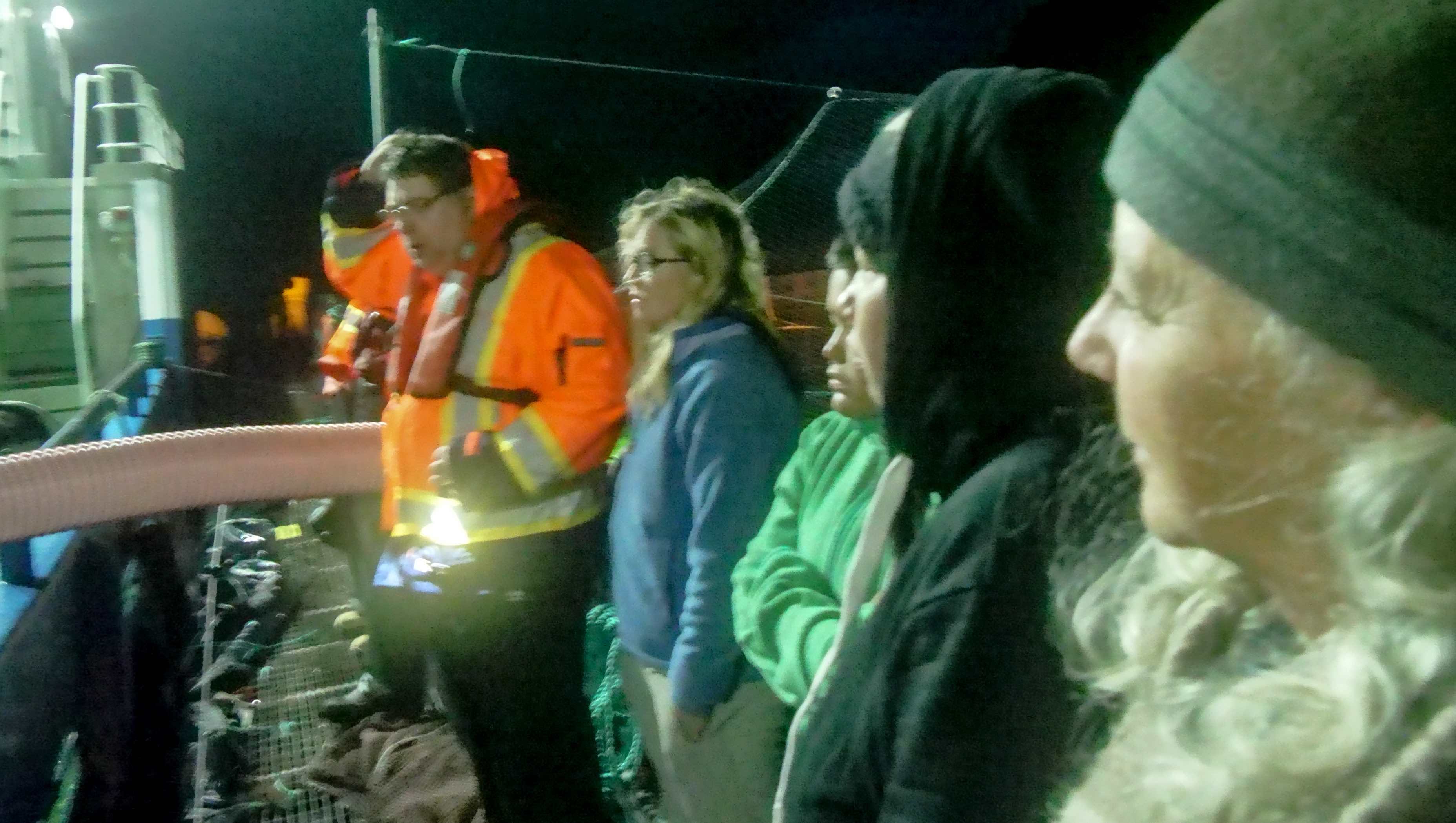
The police crowded us on the narrow walkway between the ship and the pens. We were peaceful, but none of us would move. I am in awe of the young women who stood with me. Such bravery and self-control as the tears rolled down our cheeks at the terrible thing being done to their territory, our future. As hereditary chief Robert Mountain has said only days before to premier Horgan – this is genocide. Robbing a people of their most valuable food resource is a form of genocide in a country struggling to reconcile with First Nations. One culture cannot reconcile with another while destroying their food resources.

It was sickening to see the pipe inserted into the pen and the flow begin. The police, the workers and us four women were shocked to see the amount of dead fish spewing out of the boat! Some were still gasping, but others were stone dead and began sinking immediately. In the middle of this intense stand-off Marine Harvest was actually pouring dead farm salmon from an infected hatchery into the waters of the Musgamagw as we stood on the pens in protest. Everyone stared in disbelief. These fish were from a hatchery known to have been infected with piscine reovirus, a highly contagious salmon blood virus that damages the salmon's hearts and more.
How can Minister Dominic LeBlanc continue to fight me in court to allow exactly this to go on in the face of all the evidence that piscine reovirus is a disease agent? Minister LeBlanc is disregarding the law and the RCMP were there to assist in this unlawful activity as we are threatened by the largest international salmon farming company in the world with legal action.
There is something very, very wrong here and the First Nation fight to protect the last wild salmon is bringing the depths of this terrible thing to light.
So many people are afraid of the salmon farming industry, afraid of the RCMP presence and afraid of the courts, but I am afraid of a world without wild salmon, and afraid we are loosing the capacity to fight for the living world around us. What good is it to be safe and sound in a dying world – is there anything safe about that? I have done enough of the science on this industry to know it is doing enormous damage to my world. I am being slandered and threatened for not being one of the quiet scientists, for standing up because I know how bad and wrong this situation is. All I can say is this is what my heart drives me to do. I am a grandmother. I am driven by the trust in my grandchild's eyes and I am uniquely built for this fight. I have spent over 30 years in this place, I am adopted into the Nations here, I have done the science and I have done the politics. I am standing alongside the bravest people I have ever met, young women risking everything.
I know most won't or can't step onto the front lines of this fight, but I am asking you to please help us continue. A lot of progress is being made, but it will stall and backslide if some of us can't stand toe-to-toe with those who are destroying this part of our world.
https://www.gofundme.com/last-stand-for-wild-salmon
To be continued…

Molina Dawson – standing for our future on the Marine Harvest Midsummer farm, day 70 of the occupation