The Jan 2016 BC Salmon Farmers (BCSFA) report on sea lice[1] attempts to make the case that salmon farms are not the cause of sea louse infection on juvenile wild salmon in BC and that sea lice do not impact juvenile wild salmon. Their report has no name, there is no author, it is not published and there are substantive flaws.
To achieve their conclusions, the BCSFA omit a large body of highly relevant science on the impact of sea lice from salmon farms in the Broughton Archipelago, Musgamagw Dzawda’enuxw territory. They misquote DFO research and they misrepresent the geography of this coast in regards to where salmon farms are sited.
Omission of relevant science
The BC Salmon Farmers do not cite any of the papers published on the population impact of sea lice from salmon farms on BC wild salmon in Musgamagw Dzawda’enuxw territory. Below are direct quotes from two of these papers vs. the BCSFA statement.
|
BC Salmon Farmers report |
Krkosek et al. 2007/2011 |
|
“…there does not appear to be a link between the prevalence of sea lice in coastal BC and negative impacts on wild salmon stocks.” |
“These results provide strong empirical evidence that salmon farm-induced L. salmonis infestations of juvenile pink salmon have depressed wild pink salmon populations and lead to their local extinction[2]” |
|
|
“Our results show that sea lice abundance on farms is negatively associated with productivity of both pink and coho salmon in the Broughton Archipelago.”[3] |
See Appendix one for a more complete listing of the science on sea lice in the Broughton Archipelago.
Misinterpretation of DFO Science
The BC Salmon Farmers Association misquotes DFO science. DFO reports that a pink salmon weighing less than.7g is at risk if infected with sea lice. However, the BC salmon farmers suggest a pink salmon less than .7 grams can survive heavy lice infestation. My own research reports a single motile louse/ gram body weight is a lethal load for a juvenile pink salmon[4].
|
BC Salmon Farmers |
Jones et al 2008[5] |
|
“…lethal infection level for Pink salmon averaging less than 0.7 grams is 7.5 sea lice/gram or 5.25 sea lice per 0.7 gram smolt.” |
“The present results indicate that elevated risk associated with L. salmonis infection among post-emergent pink salmon may occur during a relatively brief period before the fish reach 0.7 g” |
Misrepresentation of their own data
The BC Salmon Farmers report “sea lice prevalence is not related to the presence or absence of a salmon farm…” To support this statement they use the example of Alder Point at the west end of Fife Sound in Musgamagw Dzawda’enuxw territory where they found 73.5% of the 34 juvenile salmon they caught were infected with sea lice.
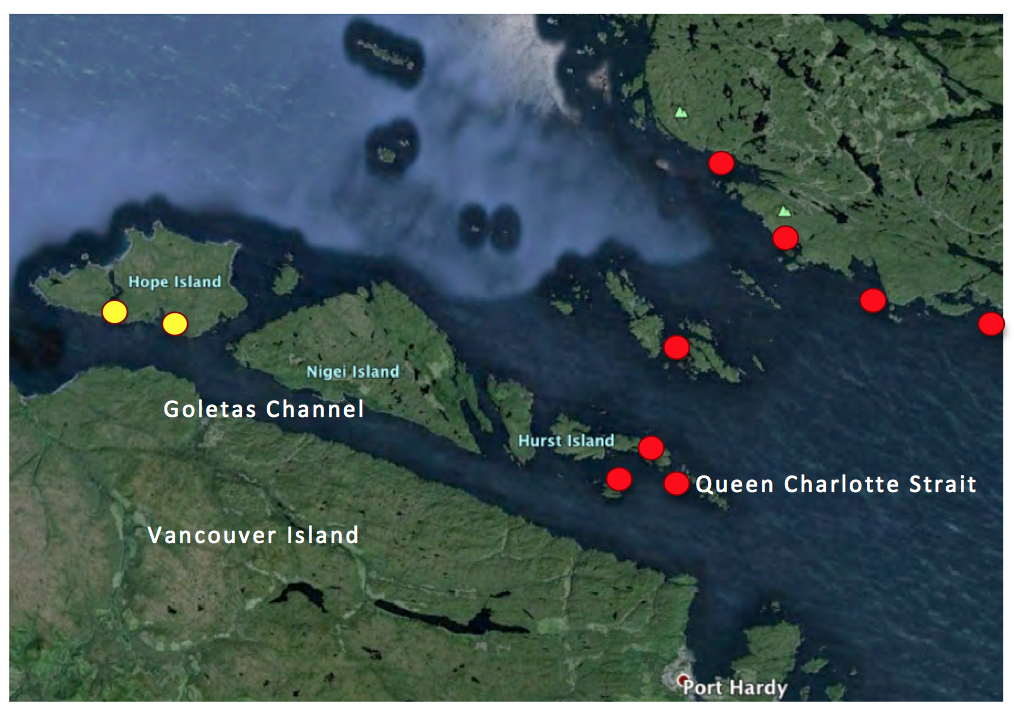
They state; “Alder Point is not located next to a salmon farm,” and they draw the conclusion the sea lice found on the fish at this site did not originate from salmon farms. However Alder Point is near a salmon farm. It is directly across the channel, less than 4 km away from the Wicklow Point a Marine Harvest site, which according to the industry was infected with an average of 6.2 motile sea lice, more than 2xs the allowed limit in BC[6] (see DFO spreadsheet below). A particle, such as a juvenile sea louse, can travel 4 km in just 6 hours in Musgamagw Dzawda’enuxw territory[7]. (See map) The large number of sea lice on the farm salmon in the Wicklow farm would have been producing millions of larval lice that would infect young wild salmon at Alder Point. It is not at all accurate to portray Alder Point as distant from salmon farms.

In addition, juvenile salmon that arrive at Alder Pt. have traveled through some portion of the Broughton Archipelago, from Kingcome River, Ahta River, Meetup River and other rivers where they have been repeatedly exposed to salmon farms. Alder Point is part of a region where much of the science on sea lice in BC has been done, reaching the conclusion that sea lice in salmon farms have impacted these wild salmon populations (See Appendix One).
Misinterpretation of geography
The BC Salmon Farmers state that sea lice abundance was 5 times higher in Goletas Channel “(away from farms)” vs. Queen Charlotte Strait “(near farms)”. Similar to Alder Point, they use this observation to make the case that sea lice are found on young wild salmon in areas with no salmon farms, therefore the salmon farms are not the problem.
However, similar to Alder Point, Goletas Channel is exposed to farm salmon effluent as there are 3 salmon farms (red dots, see map) lined up along the western edge of Goletas Channel. Goletas Channel is not “away from farms”, Goletas Channel is a highly exposed region. The two yellow dots are farm sites granted to Marine Harvest in 2015, which will increase farm salmon exposure for all the juvenile wild salmon passing through this area in 2016.
Drug resistant sea lice in Musgamagw Dzawda’enuxw territory?
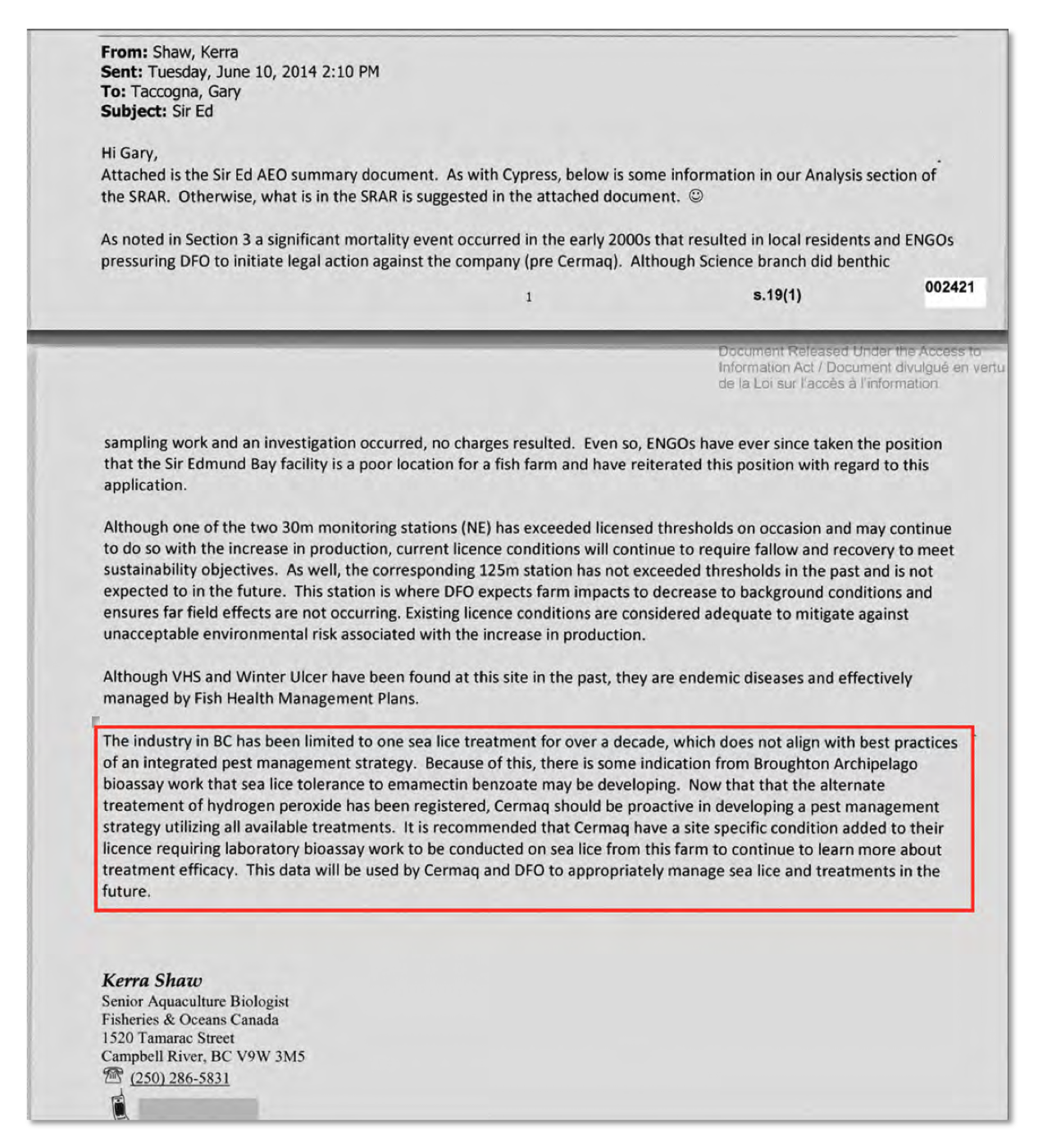
In June 2014, DFO’s senior aquaculture biologist sent an internal email stating there is some indication that sea lice in Musgamagw Dzawda’enuxw territory are developing drug resistance (see Appendix Two). This is a serious problem common to other regions of the world where these companies operate. Drug resistance leads to escalating drug use and sea lice. One year later in 2016, the Musgamagw Dzawda’enuxw lost a portion of the juvenile salmon leaving their rivers to sea lice from salmon farms with no compensation. DFO’s director of aquaculture management, Diana Trager, now dismisses the 2015 memo as an early draft that was superseded by more complete information[8]. I have requested a copy of this more complete information.
All the salmon farming companies using Musgamagw Dzawda’enuxw territorial waters to grow Atlantic salmon have their head offices in Norway, thus it is relevant to consider the state of sea lice management in Norway where the industry is currently incapable of controlling their lice and government is stepping in with strong measures. Marine Harvest’s 2015 Q4 report notes the health cost of raising Atlantic salmon is rising in Norway, Chile and Canada due in part to sea lice. In Canada health costs have increased 92% “mainly due to mitigation of gill disease and lice”[9]. This suggests the salmon farming industry is having significant problems with sea lice and because they use net pens in wild salmon migration routes, this problem is externalized to wild salmon.
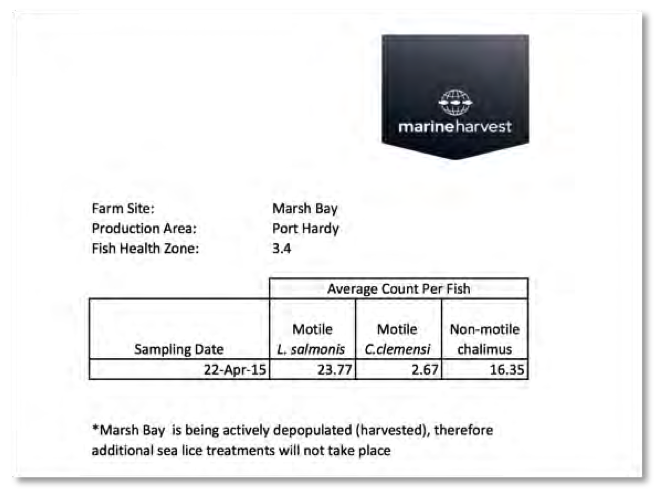 The Marine Harvest site, Marsh Bay, reported 7xs the allowable number of sea lice during the juvenile wild salmon migration period. January 2015, this farm was the 1st to be awarded Aquaculture Stewardship Certification in North America [10]!
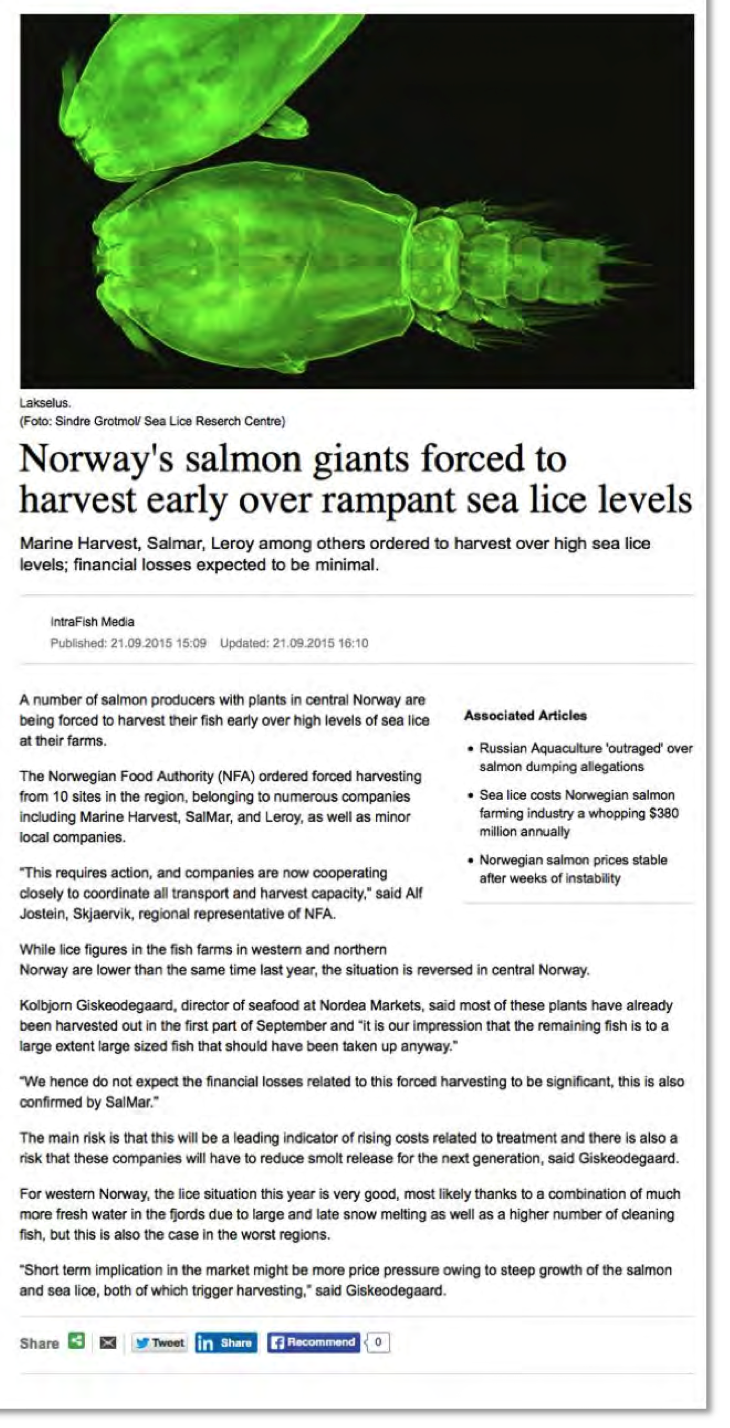
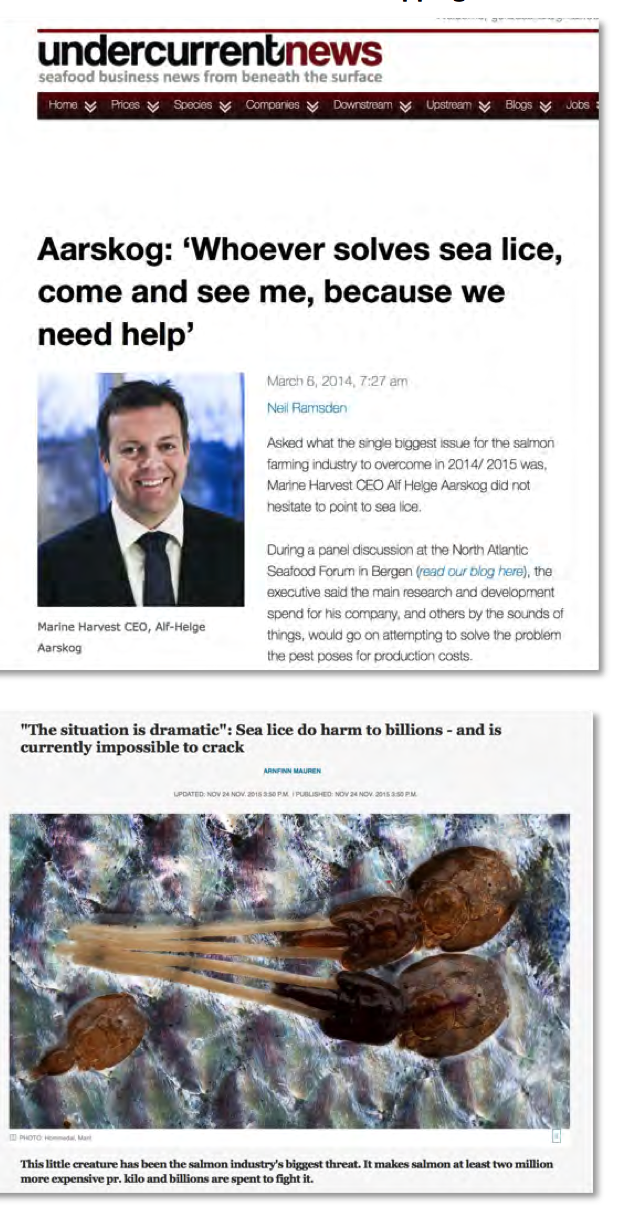
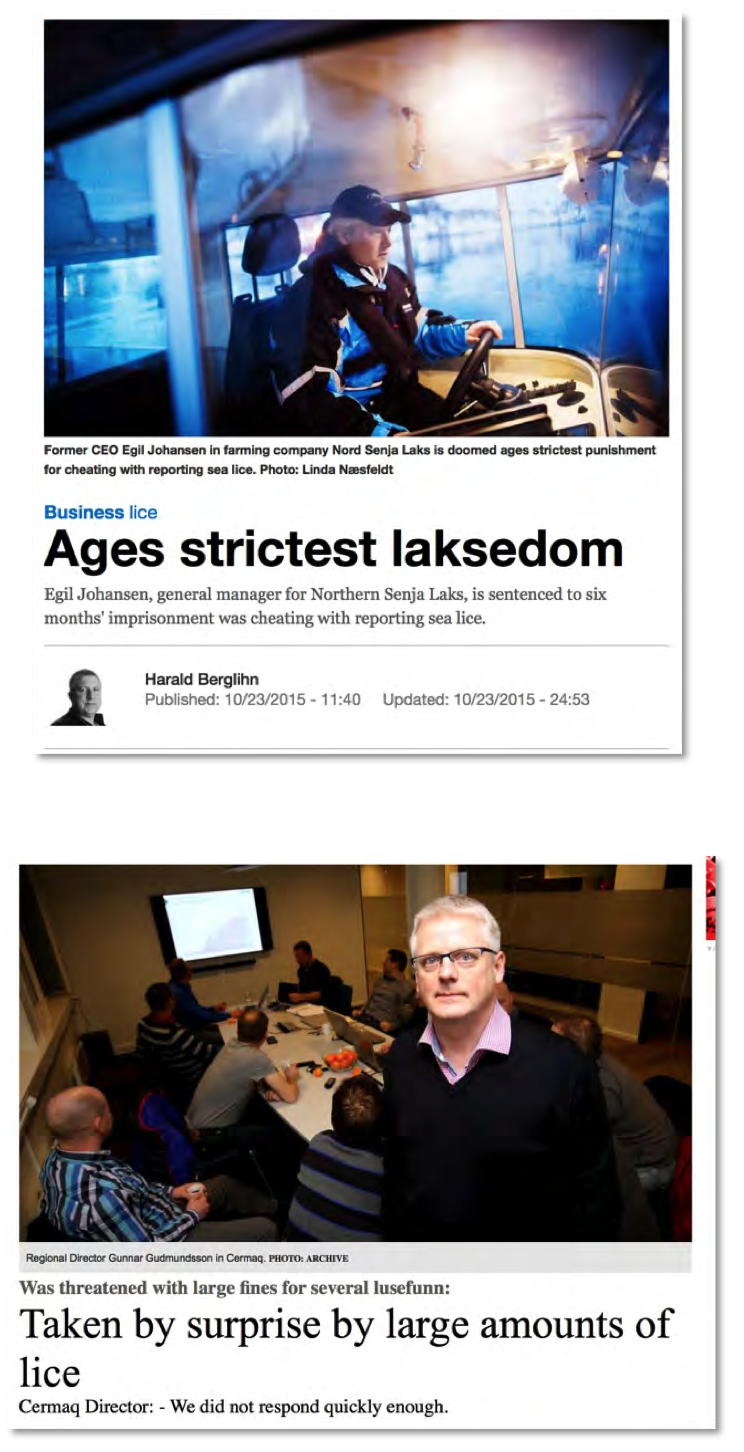
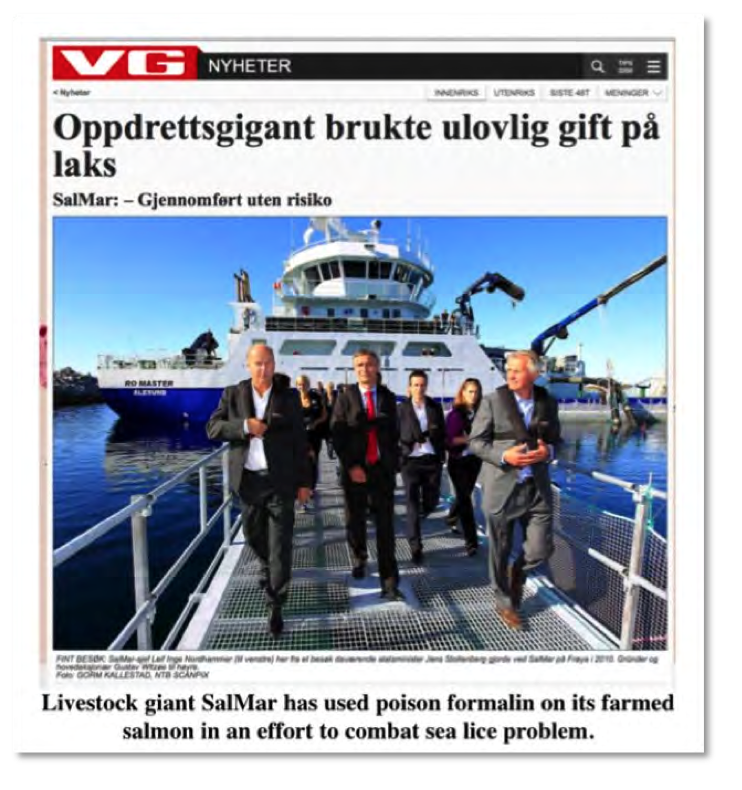
Below are headlines translated from Norwegian news that illustrate the size of the sea lice problem in Norway. If the open net salmon farming industry is incapable of controlling sea lice in Norway due to drug resistance, is it in the interests of Canadians to suffer the same consequences here?
Summary
The BC Salmon Farmers Association 2016 sea lice report omits crucial published science, misinterprets DFO science, and misrepresents the geography of this coast to put forward the conclusion that salmon farms are not responsible for sea lice infestations on young wild salmon. The 2015 sea louse outbreak was a significant step backwards for the wild salmon economy of BC and First Nations after 14 years of trying to protect wild salmon from sea lice from salmon farms. That the industry is using this highly misleading report to exonerate themselves and refuse to acknowledge that sea lice from salmon farms are a serious threat to wild salmon of British Columbia indicates an unwillingness to work together to solve this problem. It suggests perhaps that this problem can’t be solved as long as the industry uses open-net pens. Indeed this is one of the reasons the industry is moving into closed facilities in Norway.
Recent translated recent news clippings from Norway

Appendix One
Peacock, S., M. Krkosek, A. Bateman & M. Lewis, 2015. Parasite-mediated release from predation in a juvenile salmon food web. Ecosphere. 6:art264.
Rees, E., S. St-Hilaire, S. Jones, M. Krkosek, S. DeDominicis, M. Foreman, T. Patanasatienkul & C. Revie, 2015. Spatial patterns of sea lice infection among wild and captive salmon in western Canada. Landscape Ecology, 30, 989-1004.
Krkosek, M. & J. Drake, 2014. On signals of phase transitions in salmon population dynamics. Proceedings of the Royal Society B, 281, 20133221.
Peacock, S., B. Connors, M. Krkosek, J. Irvine, & M. Lewis. 2014. Can reduced predation offset negative effects of sea louse parasites on chum salmon? Proceedings of the Royal Society B, 281, 20132913.
Krkosek, M., J. Ashander, L.N. Frazer, & M. Lewis, 2013. Allee effect from parasite spill-back. American Naturalist, 182, 640-652.
Patanasatienkul, T., J. Sanchez, E.E. Rees, M. Krkosek, S.R.M. Jones & C.W. Revie, 2013. Sea lice infestations on juvenile chum and pink salmon in the Broughton Archipelago, Canada from 2003 to 2012. Diseases of Aquatic Organisms, 105, 149-161.
Rogers, L., S. Peacock, P. McKenzie, S. DeDominicis, S. Jones, P. Chandler, M. Foreman, C. Revie, & M. Krkosek, 2013. Modeling parasite dynamics on farmed salmon for precautionary conservation management of wild salmon. PLoS ONE. 8: e60096.
Peacock, S., M. Krkosek, S. Proboszcz, C. Orr, & M. Lewis, 2013. Cessation of a salmon decline with control of parasites. Ecological Applications. 23, 606-620.
Ashander, J., M. Krkosek, & M. Lewis, 2012. Aquaculture-induced changes to dynamics of a migratory host and specialist parasite: a case study of pink salmon and sea lice. Theoretical Ecology. 5, 231-252.
Frazer, L.N., A. Morton, & M. Krkosek, 2012. Critical thresholds in sea lice epidemics: evidence, sensitivity, and subcritical estimation. Proceedings of the Royal Society B, 279, 1950-1958.
Krkosek, M., B. Connors, M. Lewis, & R. Poulin, 2012. Allee effects may slow the spread of parasites in a coastal marine ecosystem. American Naturalist, 179, 401-412.
Morton, A., A. McConnell, R. Routledge, M. Krkosek. 2011. Sea lice dispersion and salmon survival in relation to fallowing and chemical treatment on salmon farms. ICES Journal of Marine Science. 68, 144-156.
Krkosek, M., B. Connors, A. Morton, M. Lewis, L. Dill, & R. Hilborn, 2011. Effects of parasites from salmon farms on wild salmon populations. Proceedings of the National Academy of Sciences of the USA. 108, 14700-14704.
Krkosek, M., R. Hilborn, R. Peterman, & T. Quinn. 2011. Cycles, stochastcity, and density dependence in pink salmon population dynamics. Proceedings of the Royal Society B. 278, 2060-2068.
Krkosek, M., & R. Hilborn. 2011. Sea lice (Lepeophtheirus salmonis) infestations and the productivity of pink salmon (Oncorhynchus gorbuscha) in the Broughton Archipelago, British Columbia, Canada. Canadian Journal of Fisheries and Aquatic Sciences. 68, 17-29.
Krkosek, M., B. Connors, H. Ford, S. Peacock, P. Mages, J. Ford, A. Morton, J. Volpe, R. Hilborn, L. Dill,& M. Lewis, 2011. Fish farms, parasites, and predators: Implications for salmon population dynamics. Ecological Applications. 21, 897-914.
Krkosek, M., A. Bateman, S. Proboscsz, & C. Orr. 2010. Dynamics of outbreak and control of salmon lice on two salmon farms in the Broughton Archipelago. Aquaculture Environment Interactions. 1, 137-146.
Connors, B., M. Krkosek, J. Ford, & L. Dill. 2010. Coho salmon productivity in relation to direct and trophic transmission of sea lice from salmon aquaculture. Journal of Applied Ecology. 47, 1372-1377.
Krkosek, M. 2010. Host density thresholds and disease control for fisheries and aquaculture. Aquaculture Environment Interactions. 1, 21-32.
Krkosek, M. 2010. Sea lice and salmon in Pacific Canada: Ecology and policy. Frontiers in Ecology and the Environment. 8, 201-209.
Krkosek, M., A. Morton, J. Volpe, & M. Lewis. 2009. Sea lice and salmon population dynamics: Effects of exposure time for migratory fish. Proceedings of the Royal Society B. 276, 2819-2828.
Krkosek, M., J. Ford, A. Morton, S. Lele, & M. Lewis, 2008. Response to comment on "Declining wild salmon populations in relation to parasites from farm salmon". Science. 322, 1790-1791.
Connors, B., M. Krkosek, & L. Dill, 2008. Sea lice escape predation on their host. Biology Letters. 4, 455-457.
Krkosek, M., J. Ford, A. Morton, S. Lele, & M. Lewis, 2008. Sea lice and pink salmon declines: response to Brooks and Jones. Reviews in Fisheries Science. 16, 413-420.
Morton, A., R. Routledge, & M. Krkosek. 2008. Sea lice infestation of juvenile salmon and herring associated with fish farms off the east central coast of British Columbia. North American Journal of Fisheries Management. 28, 523-532.
Krkosek, M., J. Ford, A. Morton, S. Lele, R.A. Myers,& M. Lewis, 2007. Declining wild salmon populations in relation to parasites from farm salmon. Science. 318, 1772-1775.
Krkosek, M., A. Gottesfeld, B. Proctor, D. Rolston, C. Carr-Harris, & M. Lewis, 2007. Effects of host migration, diversity, and aquaculture on sea lice threats to wild Pacific salmon populations. Proceedings of the Royal Society B. 274, 1341-3149.
Krkosek, M., M. Lewis, A. Morton, L.N. Frazer & J. Volpe. 2006. Epizootics of wild fish induced by farm fish. Proceedings of the National Academy of Sciences of the USA. 103, 15506-15510.
Morton, A.B. and Williams, R. 2006. Response of the Sea Louse Lepeophtheirus salmonis infestation levels on juvenile wild Pink, Oncorhynchus gorbuscha, and Chum, O. keta, salmon, to arrival of parasitized wild adult salmon. Canadian Field Naturalist. 120:2
Morton, A. B. and Routledge (2006) Mortality rates for juvenile pink and chum salmon (Oncorhynchus gorbuscha and keta) infested with sea lice (Lepeophtheirus salmonis) in the Broughton Archipelago. Alaska Fisheries Research Bulletin. 11:2, 146-152.
Krkosek, M., M. Lewis, J. Volpe, & A. Morton. 2006. Fish Farms and sea lice infestations of wild juvenile salmon in the Broughton Archipelago – A rebuttal to Brooks (2005). Reviews in Fisheries Science. 14: 1-11.
Morton, A.B., Routledge, R, and Williams R. 2005 Temporal patterns of sea lice infestation on wild Pacific salmon in relation to the fallowing of Atlantic salmon farms. American Journal of Fisheries Management. 25: 811-821
Krkosek, M., M.A. Lewis, & J.P. Volpe. 2005. Transmission dynamics of parasitic sea lice from farm to wild salmon. Proceedings of the Royal Society B. 272, 689-696.
Krkosek, M., A. Morton, & J.P. Volpe. 2005. Non-lethal assessment of juvenile Pacific salmon for parasitic sea lice infections and fish health. Transactions of the American Fisheries Society. 134, 711-716.
Morton, A.B., Routledge, R., Peet, C. and Ladwig, A 2004 Sea lice, Lepeophtheirus salmonis, infection rates on juvenile chum and pink salmon in the nearshore marine environment in British Columbia. Canadian Journal of Fisheries and Aquatic Science, 61: 147-157.
Morton, A.B., and Williams R . 2003 Infestation of the sea louse Lepeophtheirus salmonis (Krøyer) on juvenile pink salmon Oncorhynchus gorbuscha (Walbaum) in British Columbia, Canadian Field Naturalist, 117: 634-641
Appendix Two
[1] http://bcsalmonfarmers.ca/wp-content/uploads/2015/02/BCSFA_SeaLice_Report_Jan20161.pdf
[2] Krkosek, M., Ford, JS, Morton, A, Lele, S, Myers, RA, Lewis, MA. 2007 Declining wild salmon populations in relation to parasites from farm salmon. SCIENCE
[2]Krkosek, M, Connors, B, Morton, A, Lewis, M, Dill, L, Hillborn,R . 2011 Effects of parasites from salmon farms on productivity of wild salmon. PNAS
[4] Morton and Routledge. 2005. Mortality Rates for Juvenile Pink and Chum Salmon Infested with Sea Lice in the Broughton Archipelago. Alaska Fishery Research Bulletin
[5] Jones, S, Kim, E, Bennett, W, 2008 Early development of resistance to the salmon louse, Lepeophtheirus salmonis (Kroyer), in juvenile pink salmon Oncorhynchus gorbuscha (Walbaum) Journal of Fish Disease
[6] http://www.pac.dfo-mpo.gc.ca/aquaculture/reporting-rapports/docs/lice-pou/2015/Q2-T2/A-eng.pdf
[7] Foreman, GG., Chandler, PC., Stucchi, KA., Garver, M., Guo, J., Morrison, J., Tuele, D., The ability of hydrodynamic models to inform decisions on the siting and management of aquaculture facilities in British Columbia. CSAS 2015/005
[8]http://www.vancouversun.com/lice+outbreak+shows+links+salmon+farming+report/11728714/story.html?__lsa=0aee-165d
[9] http://hugin.info/209/R/1986635/728909.pdf
[10] http://www.marineharvest.ca/globalassets/canada/wharfside-newsletters/2015-newsletters/february/mhc-newsletter-february-2015.pdf