Following the recent hearing in Federal Court of my lawsuit over the transfer of fish carrying disease agents into to the Ocean, Marine Harvest was quoted in two European news articles, Undercurrent News and FIS. Their statements suggest that the science is settled with respect to PRV and the risk it poses to wild fish in the Pacific Ocean. These statements are misleading and warrant a response.
June 9 2014, I took Canada and Marine Harvest to federal asking the court to decide if it is legal for Canada to give salmon farming companies the power to transfer diseased salmon into net pens in the ocean. Canada appears to have given the companies this power through the transfer conditions in their federal aquaculture licences. Although the case was about one licence given to one company, it appears that all federal licenses contain these transfer conditions. The farm in question is on BC's wild salmon migration route – as are many other fish farms operating on the Pacific Coast.
Lawyers Margot Venton and Lara Tessaro with Ecojustice argued that: no, this is not consistent with the laws of Canada. In particular the transfer conditions are contrary to s. 56 of the Fisheries Act General Regulations which requires DFO to make the decisions about each transfer of fish and that they may only be transferred if they are not carrying disease or disease agents that may be harmful to the conservation and protection of fish. This case is based on one particular March 2013 transfer of farmed Atlantic salmon infected with the piscine reovirus from a hatchery near Sayward, BC to a salmon farm on the migration route of the Fraser sockeye – but it could set a precedent for all salmon farms in BC.
We await Court’s the decision. This is a very important decision and could make all the difference to how much disease BC wild salmon are exposed to and ultimately their fate as feedlot environment viruses are known to be dangerously virulent.
 Another viral Load?
I found the statements by Marine Harvest about me offensive, but they also deserve clarification.
Specifically Marine Harvest states they have provided “independent third party evidence that confirms”:
1. Piscine reovirus is natural to BC and has always been here
2. It is not associated with the salmon heart disease, HSMI
3. That the disease HSMI has never been found in BC
Whoa cowboys slow that runaway pony down, aren't you are getting a little ahead of yourselves!
If Marine Harvest wants us to believe these claims are true, show us the publish peer-reviewed scientific. You can't just make it up as you go along, especially in light of the fact that what science does exist in the public domain comes to opposite conclusions; that the virus is new to BC, causes HSMI and the Province of BC fish farm vet is reporting the symptoms of HSMI in BC farmed salmon.
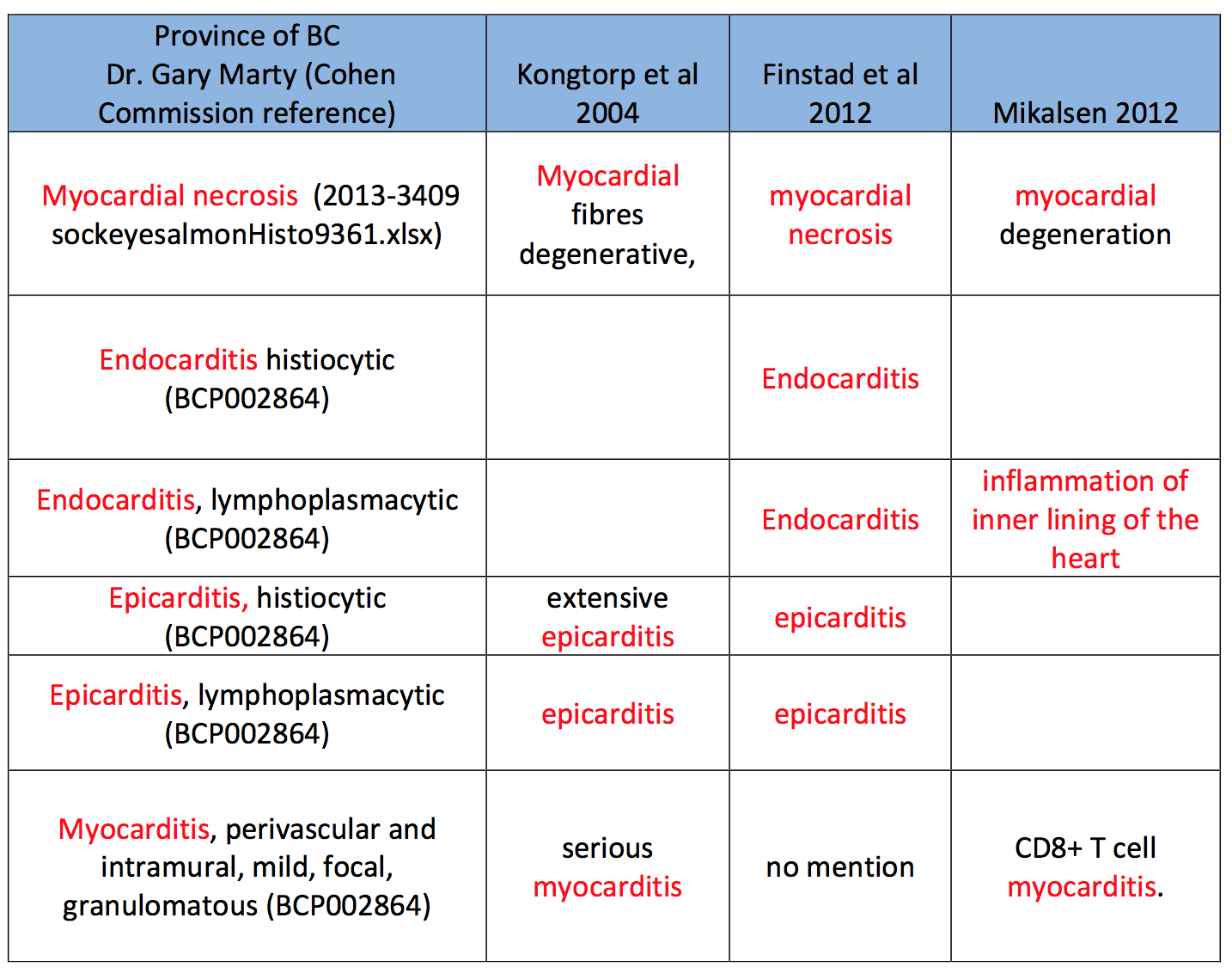
"This pattern of inflammation has also been described with Heart and Skeletal Muscle Inflammation [HSMI] in Atlantic salmon reared in Europe, but this disease has not been identified in BC salmon.” (Aug. 29, 2008 report to Mainstream, Cermaq, largely owned by the Norwegian government, by Provincial vet Dr. Gary Marty)."
Below is a chart comparing the farmed salmon heart damage found in BC vs the heart damage that is diagnostic of the disease HSMI in Norway.
References for chart:
However, this issue is greater than one virus and one disease. It is dangerous to let any virus replicate in feedlots and then pour into the environment, because feedlots cause pathogens to become more lethal. Here is how:
a. Feedlot crowding means that when one fish dies the virus has 599,999 others to infect and so it survives easily. In the wild, a virus that kills its host is cast adrift in a vast ocean as the healthy salmon keep traveling.
b. In the wild, viruses benefit from keeping their host alive, but in feedlots there is no future. All the fish die in 18-24 months at harvest time. So feedlot viruses are known to replicate as fast as possible, each replication carrying the risk of mutation. Mutation is the wild card that brings us the superbugs.
c. Lethal viruses don't spread easily in the wild, because weakened fish are taken out of circulation by predators. Infected farmed salmon, however, die slowly, shedding more and more virus. This means wild salmon passing salmon farms can get a heavy dose of disease. This is not part of their natural history. They are not equipped to survive this.
d. With salmon farms in their habitat, none of the wild salmon’s natural anti-disease mechanisms work, the system is breached, broken. Disease rules.
In closing
If Marine Harvest wants to pay for research to fight a legal challenge they are free to do so. But if they want any credibility they need to subject their theories to the scrutiny of the scientific community who are experts on this disease.
I think the flurry of articles in European press reflects nervousness. The salmon farming industry is fighting for its survival in BC. Most of the Atlantic salmon I have tested in BC from supermarkets are infected with piscine reovirus. This is serious.
I am fighting for the survival of BC’s wild salmon. If this virus and all the other pathogens in salmon farms weaken wild salmon they are becoming less resilient, more vulnerable and when times get tough, we will lose them.
I await Justice Rennie’s decision.