British Columbia is poised to be designated ISA virus positive. A few weeks ago the Office of International Epizootics, OIE, changed the definition of an ISA virus positive region.
Instead of having to diagnose the disease, today detection of any strain of the virus is enough to designate a region as ISA virus positive. This is the difference between a person being HIV positive, or having AIDS.
This change means a place like BC, could move fast enough to stop a full-blown epidemic. The ISA virus has been detected by the North American OIE reference lab for ISA and two other labs. DFO got positive ISA test results in 2004, but hid them. Now the federal Canadian Food Inspection Agency may be causing a dangerous delay, risking wild salmon of the North Pacific.
The Globe and Mail reports today that the Canadian Food Inspection Agency (CFIA) has written to the Office of International Epizootics (OIE) asking that the Kibenge Lab at the Atlantic Veterinary College, PEI be stripped of its standing as one of only 2 ISA virus reference labs. The second lab is with the Norwegian government.
There are 169 comments, over 2,00 shares and facebook posts in response to this article! Here is one:
“Good on you Mr. Kibenge. As a fellow scientist I have witnessed first hand the sweeping layoffs targeting the PC (physical scientist) designation in government.
It is our responsibility to stand up for the safety and values of Canadians regardless of what the current regimes mandate is.”
ISA virus is in the influenza family. If it is in BC it is absolutely essential that it be stopped from spreading, because it appears to be European. This means the wild fish of the North Pacific may not have enough immunity to it.
It was Dr. Kibenge who accurately diagnosed ISA virus for the first time ever in Chile. That virus exploded within weeks of his diagnosis to cause $2 billion in damages, to the Chilean salmon farming industry. Chile, however, had no wild salmon to lose. For BC the stakes are even higher. No one knows what this virus will do to wild Pacific salmon if it is left to spread – NO ONE.
Could the CFIA just be engaging in due diligence? Perhaps, but there are extenuating circumstances.
When the OIE applies their ISAv designation upgrade to British Columbia by accepting the results from their lab British Columbia’s status would have to be altered from ISAv-free to ISAv-positive.
The CFIA testified under oath at the Cohen Commission in December 2011 that if the ISA virus is confirmed in BC, BC farm salmon trade could cease. The Provincial Minister of Agriculture echoed this stating in the BC legislature that US and Asian lawmakers were pushing to close their borders to BC farm salmon as a result of the first ISA virus positive test results from Dr. Kibenge’s Lab. One has to ask if this is why the CFIA is trying to disconnect Dr. Kibenge’s lab from the OIE?
If the CFIA is successful, they will destroy any hope of a fast response. The research will continue, but we will be at the mercy of this virus, giving it the opportunity to do what it does best – Go Viral
The directive to protect wild salmon has to come from us, because there is no one else who can do this. This is a very ominous development.
Dr. Kibenge will speak about this tonight on CBC “As it Happens”.
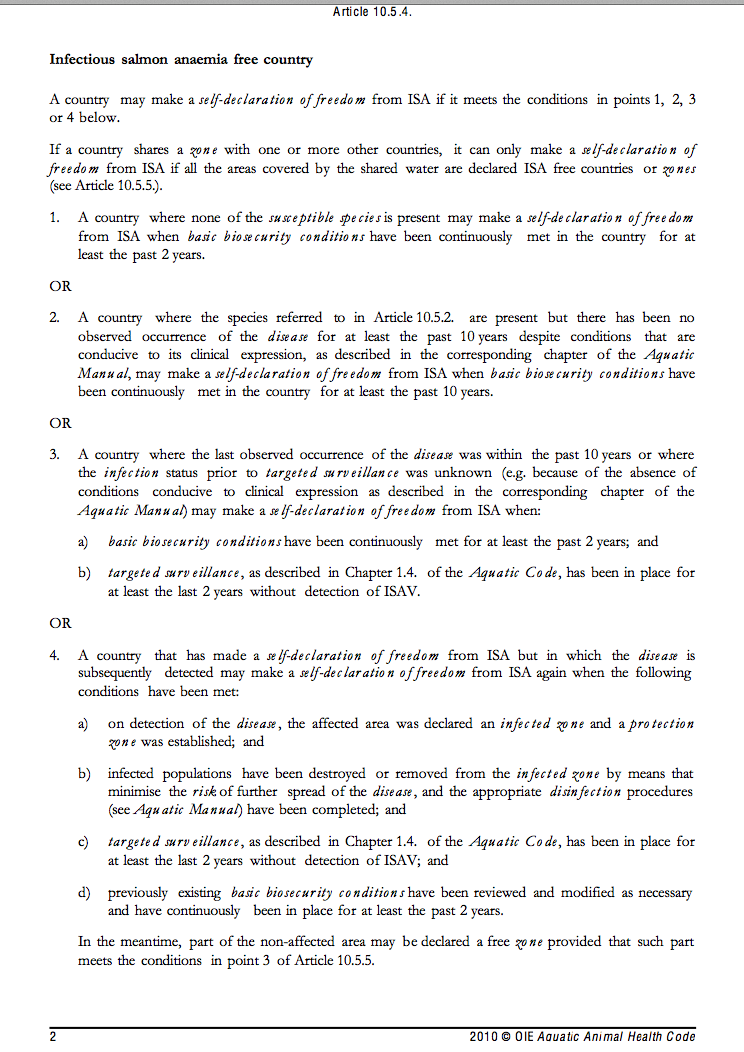
OIE Changes
1. The OIE removed “whole eviscerated fish” from the list of products that can be imported without risk analysis from and ISAv positive region
2. They changed the definition of “ISA – free” from: ISA disease to “detectable” ISA virus
September 2012 revised recommendations:
A region is not ISA virus free if the virus is “detectable”

Download aahc_infectious_salmon_anemia_81_uo_sep12 copy.pdf (174.2K)
Original Recommendations:
There is no mention in the original document of detectable ISA virus – they only refer to the disease. It is the difference between HIV positive and AIDS.

Comments
13 responses to “BC Poised to be Designated ISA Virus Positive? – CFIA steps in”
The question arising is:
How is the Office of International Epizootics (OIE) governed? Is it by considerations of public and ecosystem health or is it governed by trade and commerce considerations?
One wonders.
Test labs by their nature produce results that are unpalateable to some of the stakeholders. That is how it is supposed to work.
When a designated laboratory and it’s principals are pilloried for alleged systemic failures in procedures, is the audit on which this is based at arm’s length from either the host country or the complainant country?
And are the auditors appropriately at arm’s length, properly qualified and is the process transparent and accountable.
It seems to me, given the complexity of the political issues, that it does neither the CFIA or the OIE much credit if the issues of fish health are comingled with international trade issues. Both the host country for the lab, the complainant country and the host academic institute have some explaining to do on why the process is seemingly neither balanced, proportionate, transparent and accountable.
Further, for Canada, the implication for outside observers is that ecosystem risk is not considered a “real” risk.
Can the CFIA explain?
-30-
how do I put this info on my facebook page?
You are really stretching the truth here. From what we can tell from reading this nothing will change in B.C. Farmers already test for and report all strains of the virus. First-step PCR tests showing weak positives don’t count unless they can be confirmed. This has not happened, despite your claims to the contrary (and despite your refusal to publish test results to back up your claims).
@ Salmon Farm Science:
Someone is stretching the truth but I do not think it is either your comments or Ms. Morton’s comments.
The CFIA and by implication the DFO, have not covered themselves with scientific glory.
In any scientific endeavour, false positives are as bad as false negatives and I have a great deal of difficulty understanding just how one lab can pillory the reputation of a second lab without disclosing the evidentiary elements.
I am not a molecular biologist (or any biologist for that matter). But I thought that one element of the Cohen Commission was that unless there are common evidentiary and scientific standards, both sides of the argument will be talking past each other.
There has to be some neutral, independent arbiter of the scientific evidence.
The DFO used to be this arbiter but this now seems unlikely. The Cohen Commission was as close as we will ever come to a dispassionate finding but already the good will coming from the Cohen Commission has been dissipated by ad hominem attacks by agencies that should know better (but do not)
The casualty of all this evidentiary warfare is the truth – and with it the public interest for all parties.
-30-
Edivos – click on the title of the article, then copy the link and paste that onto your facebook page
Fishfarmscience – What you say is extremely interesting. “Farmers already test for and report all strains of the virus.” When you say THE VIRUS, are you saying BC salmon farmers are reporting strains of ISA virus? I am sorry you are not in the loop, but I can’t publish the results I am getting right now. It is frustrating for me too. Please be patient.
I tried to sign the petition above – it didn’t work.
Would you consider putting a donation button on your pages (paypal etc). I would donate.
Why should the CFIA be explaining what the OIE is responsible for? OIE reference designation is bestowed by the OIE – not the CFIA. Even if the CFIA pleaded and begged the OIE to strip the AVC lab of its ISA reference status it is the OIE that is ultimately responsible for that certification – not the CFIA. Perhaps questions should be directed to the OIE and see why they have taken the action they have. I would be interested in hearing their version of events and why they have taken the measures they have so far. Perhaps that can be posted here in order to be objective as possible? Maybe even talking to the Dean of the AVC might help as his version of events seem to be different.
@steve:
Steve:
The OIE, despite it’s sterling reputation, has nothing on it’s web site that directs the interested reader towards the Kibenge audit, who did the audit and when the decertification was recommended by OIE.
Transparency is not evident
Since the OIE has no trans-national legislative authority, any powers, if any, would be carried out by the CFIA.
The trouble, is with the existing lack of transparency at the CFIA, we do not know when they are acting as agent for the OIE or when they are acting in the Canadian public interest (the interests are not the same)
So we are left with a situation where the ordinary citizen cannot tell who is directing the CFIA in their decertification bid , who did the audit, were they qualified, and was there due process observed (rules of natural justice).
Very disturbing to the ordinary citizen.
If there are two labs, false positives are as bad as false negatives so where is the international lab “round robin” on standards and accuracy ?(round robins are fairly common among international standard setters)
If you know where the audit is published, let us know as many of us ordinary citizens would like to read it.
-30-
Don,
The OIE posted a release about this audit on November 27th on their website (see below). However, the OIE has not officially decertified the AVC lab according to the press release. It appears no official action will be taken until after meetings in May 2013. As you can see from the press release, OIE reference lab designation is enforced by the OIE. They appear to take this seriously and have acted to protect their reputation – the same standards fish farm activists have held up as the best around. The OIE conducted the audit and will make the final decision on whether the AVC keeps its OIE ISA reference lab designation. I realize that fish farm activists love to drag the CFIA over the coals for this, but this is not in the CFIA’s hands. Again, this is OIE reference lab designation – not CFIA reference lab designation.
The CFIA acting as agents for the OIE? That’s a real stretch (“snap” goes the tree limb). Where are your facts? So, basically you believe that the OIE is easily influenced with regards to its standards? Fish farm activists should be careful about knocking the OIE if they are depending on hanging their hopes on their reputation. By knocking them, activists are basically discrediting their samples and the test results from AVC. What it sounds like to me is that you are eager to accept the good things about OIE reference designation when it appears to align with your beliefs, but just as eager to throw the organization under the bus when it appears to question test results from activists. If fish farm activists are concerned about having good, defensible results from a worldwide approved body which attempts to provide “high quality disease diagnostic services” then they should have no problem with this audit and any corrective measures that are deemed necessary by the OIE. What’s more important? Good, scientifically defensible results which further our knowledge about diseases or poor results that are not done to the “highest technical and operational standards” which mislead and confuse the general public about what diseases (or viruses) are there? If you were a biologist at a lab that was doing similar testing and it was determined (through an audit) that there were a series of weaknesses in your lab’s protocols and procedures wouldn’t you want to know about it and have it fixed to protect your reputation?
I do not wish any ill will towards Dr. Kibenge or the AVC lab. This is not a competition – it should be about getting the best information possible for everyone. Shame on individuals who attempt to politicise this particular issue at AVC in the media to distract the general public. Whatever the problems are at the AVC lab I hope they are corrected so that OIE will no longer have anymore concerns.
http://www.oie.int/en/for-the-media/press-releases/detail/article/information-on-oie-reference-laboratories/
@steve
No, my name is not Don. And yes, I am a Canadian citizen.
Thanks for the OIE link.
I note the OIE media release is dated November 27th, 2012. Yet the media reports on November 24th were that the CFIA spokesperson was flagging the audit and the credibility problem on November 23rd, 2012.
Either the OIE is inept at releasing results that have considerable implications for the Canadian regulatory system or the CFIA could not resist flagging the credibility issue.
No kudos for either the CFIA or the OIE in this matter.
But more to the point, the audit has not been released, the auditors are not identified and the results of any round robin ISA testing among the many labs is not identified.
Scientific due process seems lacking.
I think the citizens of BC are owed a defensible explanation of why either the ISA virus results are in error or why the lab at the AVC is so seriously compromised that only DFO results should be trusted.
There is a lot at stake, not just regulatory credibility.
-30-
Alexandra:
Indeed, the CFIA had actually declared a PR “war” in inferred agenda — as was publicly established in submissions during the Cohen Commission hearings — to specifically turn public opinion AGAINST acknowledgement of the potential presence of ISA virus in BC waters, despite the existing and growing supporting evidence, effectively to produce PR results IN FAVOUR of salmon farming/aquaculture industry interests, regardless of the potentially devastating environmental consequences.
In particular, I am referring to the revealing November 9, 2011 internal email communication statement originally issued by Joseph Beres, an inspection manager of CFIA B.C., to colleague Dr. Con Kiley and other senior CFIA and DFO staff in reference to a preceding public press teleconference hosted by the CFIA and DFO:
“Con,
It is clear that we are turning the PR tide to our favour -– and this is because of the very successful performance of our spokes[people] at the Tech Briefing yesterday -– you, Stephen, Peter and Paul were a terrific team, indeed. Congratulations! ONE BATTLE IS WON, now we have to nail the surveillance piece, AND WE WILL WIN THE WAR ALSO.
Cheers, Joe.”**
In the same strain, Dr. Kiley replied, “CONCENTRATE ON THE HEADLINES, THAT’S OFTEN ALL THAT THE PEOPLE READ OR REMEMBER.”**
[EMPHASES ADDED]
It has been clear from the onset that the CFIA, in its role as a national governmental agency (wherein its legislative mandate is the protection of BOTH wild and farmed aquatic animals), has not been impartial whatsoever, and has since had an established agenda AGAINST the interests of wild salmon and related priorities — despite growing evidence of the presence of ISA virus and other aquaculture-enhanced pathogens potentially affecting wild species in BC waters. Their resultant drastic actions with the specific intent of shutting down and effectively muzzling an internationally renowned reference laboratory facility which has been in contravention of their set agenda, merely confirm this very assertion.
With respect to this, there should have been no great shock in response to the CFIA’s eventual actions against Dr. Kibenge; they had already been dealt in the cards.
** SOURCES: ‘Winning the Salmon PR ‘War’? Emails Reveal Government Scientists Acting Like Flacks’, The Canadian: http://thecanadian.org/k2/item/1226-winning-salmon-pr-war-cohen-commission-gillis; Cohen Commission Inquiry — Aquaculture Coalition submissions, pages 13-14, exhibit 2110: Email from J Beres to C Kiley et al, re Fwd — The Early Bird — Nov 9 2011. ISAV, Nov 9 2011.
Whether one is for,against or neutral about fish farms, the convoluted CFIA/OIE process leaves ordinary, reasonable observers sceptical about the ability of Canadian fisheries regulators to deal with scientific and regulatory uncertainty.
In fact, a reasonable observer who is neither a molecular biologist or a fisheries biologist might conclude that the very same regulators dismiss science in large measure.
Of course, the same observers might conclude that all is well if they had access to audits and regulatory studies.
That said, the OIE (former ?) ISAV reference lab in PEI is hardly a stranger to scientific uncertainty or interlab round robin studies which makes the latest imbroglio all the more puzzling. The lab by any standard is a leader in molecular biology.
For example, the OIE PEI lab head was a co-author with other experts of a paper in 2010 on minimum standard guidelines for fluorescence based quantitative real time PCR experiments. The authors call for more transparent and comprehensive reporting policies.
Paper:MC Mol Biol. 2010 Sep 21, MIQE précis: Practical implementation of minimum standard guidelines for fluorescence-based quantitative real-time PCR experiments.
Authors: Bustin SA, Beaulieu JF, Huggett J, Jaggi R, Kibenge FS, Olsvik PA, Penning LC, Toegel S
And further, very recently Kibenge and others published a broad ranging paper on countermeasures against viral diseases of farmed fish.
Paper: Antiviral Research 95 (2012) 257–281 Countermeasures against viral diseases of farmed fish:
Authors Frederick S.B. Kibenge a,⇑, Marcos G. Godoy b, Mark Fast a, Samuel Workenhe c, Molly J.T. Kibenge
For the CFIA and the OIE to claim scientific irregularities in the PEI lab without ever publishing the basis for this claim, is hardly an indicia of evidence-based regulation.
If there is a case to be made, then release the evidence. Otherwise the main casualty is the truth.
-30-
There has been remarkably little serious media discussion of the dangers of basing regulatory decisions of great economic and environmental importance on uncertain data.
You can be for, against or neutral about fish farms but the disparaging of the test lab and the sample collectors in connection with the ISA virus in BC is an ominous portent for balanced fisheries management in BC.
Instead of an avalanche of pejorative comments, there might even be a simple explanation if anyone did the proper testing.
It is an arguable thesis requiring further study that there may a low impact ISA virus present in the west coast that is not signalled in all the viral tests. And with it, the danger of overlooking the potential for a high virulence outbreak some time in the future.
All this was argued to varying degrees during the Cohen Commission but the Cohen report did not resolve the matter. However, a (mythical) reasonable observer might conclude that there are some indicia of an errant ISA virus in BC waters that cannot yet be entirely explained but which cannot be entirely explained by the blanket denials of the CFIA/DFO. After all, the usual labs testing for ISA are used to dealing with Atlantic and North Sea species. The Pacific, as I hope we know, is not biologically identical.
So what will it be?
Blanket denial of ISAV or continued research?
Some leadership from the CFIA/DFO please.
-30-