Last week I received further test results from Dr. Kibenge’s OIE reference lab
There are four milestones in detection of ISA virus (salmon flu) in salmon:
1- visual sign in the organs
2- PCR positive result
3- sequencing the virus
4- finding the live virus and culturing it.
Last week we reached level 3. The ISA virus genotype HPR5 from a female chum salmon that had spawned in the Vedder River was sequenced. Cultus Lake drains into the Vedder River. In 2002/3 DFO found 100% of the sockeye tested from Cultus Lake produced ISAv positive results. DFO did not believe their results and did no further testing – see blog below for further information on this. proDownload HPR5 sequence Vedder Chum.pdf (96.8K)
As well, five of the 29 Atlantic salmon heads purchased from supermarkets in Vancouver produced ISA virus positive PCR results. Of these Dr. Kibenge was able to further identify the ISA virus variant as HPR5 in one and HPR7b in another: Download Atlantic salmon heads HPR5 HPR7b.pdf (109.8K)
Both of these variations of the ISA virus have been known to kill salmon. HPR5 has been reported in Selji Norway (Devold et al. 1995) and HPR7b was the dominant mutation in the ISA virus that swept through Chile in 2007-2009 causing 2 $billion in damages. Godoy et al (2008) include a picture reporting jaundice as one of the clinical signs of the Chilean ISA outbreak.
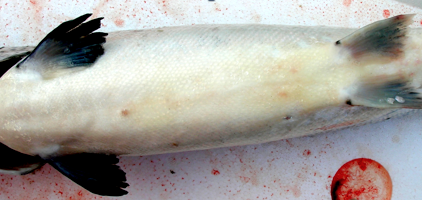
Jaundice (yellow colouring) has become a concern in BC in wild salmon and is also reported in farmed chinook salmon in Clayoquot Sound where ISA virus was detected. Provincial vet Dr. Gary Marty reports jaundice in the farmed chinook is unrelated to the ISA virus reported in these farms (Cohen Exhibit 2078). The company that owns these chinook farms contracted DFO to help them learn why these yellow chinook are dying. There has been no visible response to cull these farm salmon in response to ISA virus detection as is practiced in every other country dealing with this.
The ISA virus findings I am reporting here do not prove these viruses came from Norway or Chile, the lab report indicates only that they carry the same mutation. They may or may not be related to the Norwegian or Chilean strains. A Pharmaq Newsletter has this to say about HPR7b, “When ISA reached Chile, the HPR7b strain was known, which was the cause of the worst outbreak in the industry’s history… it is in the ‘virulent’ category and is one of the most infectious worldwide, characterized by being highly deadly and contagious.” This is not a scientific journal, it is an industry newsletter. Gonzalez et al. (2011) call HPR7b Chile’s “most virulent” strain. HPR7b has also been found in Scotland (gene bank Acc. No. AF283997) and HPR5 has been found in Chile (EU625667). Kibenge et al (2009) report HPR7b was ~80% of the ISA strain found in Chile during the outbreak, there were multiple strains.
These mutations have caused large mortalities in other places, and I don’t know how we would know if there have been large losses of BC feedlot salmon or not because they, and their government handlers, are so secretive. As I did inventory on the salmon feedlots in the Broughton this weekend, I was surprised at the number of empty farms and that Cermaq has moved their brood site out of Cypress Harbour for the first time in over a decade.
I am posting these results because I believe the way forward is to end the era where disease in farm salmon has been a federal and provincial secret. I continue to hope that government will respond to protect wild salmon and herring. The exact source of these fish is unknown, though they were sold as fresh BC product. At the moment water used to clean these is running into the Fraser River Delta.
If you would like to send a letter to the provincial government and parties this link has been prepared by a supporter, Huguette Allen
Thank you to Eddie Gardner, Ivan Doumenc, Sabra Woodworth and Nicole MacKay for your volunteer help in getting these results and to Anissa Reed. Below is a backgrounder on ISA virus findings and testimony in British Columbia.
Comments
2 responses to “More ISA virus test results”
You failed to mention this line from Kibenge’s lab report: “The OIE definition (confirmation) of ISAV infection requires that the virus be successfully grown in cell culture and identified. Because additional testing by virus isolation is not possible, these results do not confirm ISAV infection.”
You also failed to mention that, as the lab report states, the positive results in the chum are weak (near the detection limits of the test).
Thank you for posting the entire lab report so people can read it for themselves.
Interesting: Salmonfarmscience points out the ISA test results on the Vetter river chum is a weak positive. Now the lab doing this work has sequenced the “weak positive” sample and it is the HPR5 flavor of the ISA virus which originates from Norway. I have never heard of Pacific salmon being harvested in the Nort Atlantic. How is it possible for HPR5 from Norway to have infected a B.C. Pacific chum salmon?