People of this coast think it is important to communicate with the Norwegian delegation visiting BC and so we are taking this opportunity wherever we can. Yesterday Sabra Woodward and Elena Edwards met the Norwegian Parliamentarians in Victoria as they walked from the Empress Hotel to the Royal Museum handing them the letter below this blog. They said the delegates were eager to communicate and asked questions. I joined a group of people today prepared to greet the delegation as they boarded the ferry and ride with them to Quadra Island.
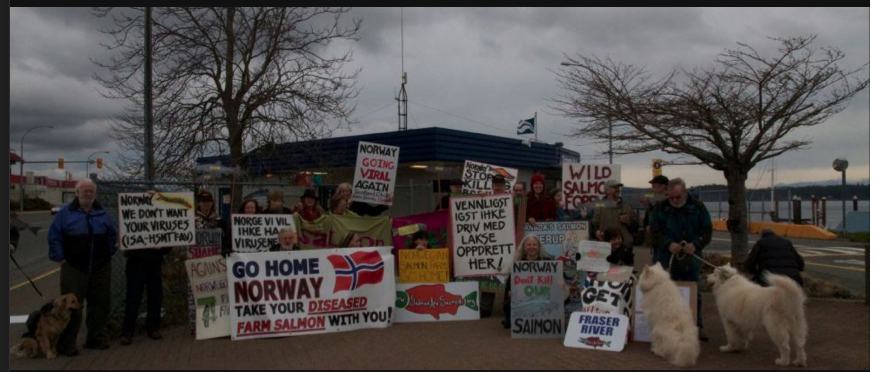
As we stood in the brisk morning more and more people assembled each with signs and painted fish. I got an anonymous text that plans had changed; the Norwegians were not going to be taken to Quadra, because of concern about a protest. I don’t know what they were concerned about, meeting with the people of BC? Norway needs to know how their feedlot industry is viewed here.
We stayed at the ferry until it left and then went to the Golf Club. There our numbers grew again and we formed a line holding our signs to the dinning room. We thought we should warn them about John Duncan MP, because the government he is part of hid the ISA virus positive test results from the federal inquiry into the Fraser sockeye.
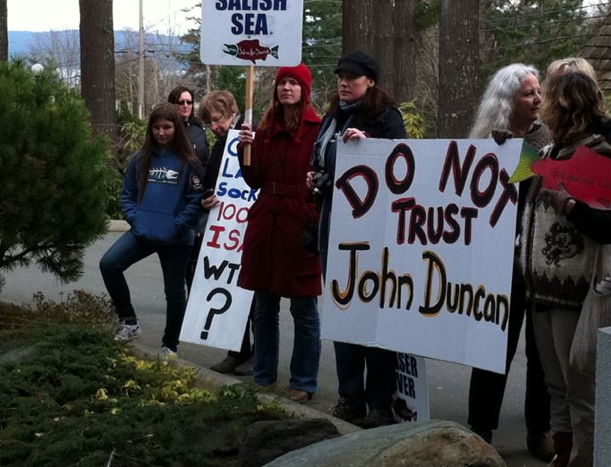
I was instructed by the First Nations between Kingcome and Knight Inlets to continue my fight for wild salmon against this industry and was named and adopted last week. I asked if I could wear the button blanket of whale and salmon when I stood for wild salmon in Campbell River before the Norwegians and was given permission. So I placed the beautiful symbol of a people deeply tied to wild salmon on my shoulders and stood with the growing crowd. When the bus appeared, Rod Marining, one of the original founders of Greenpeace, stepped in front of the bus to stop it.

There were tense moments as the vehicle tried to go forward, but then the door opened and out stepped Dag Terje Andersen, president of the Parliament of the Kingdom of Norway, Per Sandberg, Deputy Parliamentary Leader and Chairman of the Standing Committee on Justice and others. Mr Andersen extended his hand to me asking if I was their leader. I think he was drawn by the power of the beautiful button blanket. I told him we have no leader.

I told this very powerful man in the government of Norway, which is the biggest shareholder in Mainstream Canada, the fish feedlot company that sued Don Staniford, that we don’t trust our government because they hid the ISA virus from their own inquiry into the demise of the Fraser sockeye. I said I am convinced the Norwegian salmon feedlots are responsible for the decline of the sockeye – that the one Fraser sockeye run that migrates southward via a salmon farm-free route are doing so well they were designated BC’s only “salmon stronghold.” He countered that the industry was good for small communities, but I told him the industry doesn’t hire many people at all, it is highly mechanized and doing so poorly Marine Harvest fired 60 people recently. I told him the industry destroyed my town of Echo Bay, near Kingcome Inlet. I told him Norway should be ashamed of the way this industry treats people. He said the environment should come first. This we agreed on.

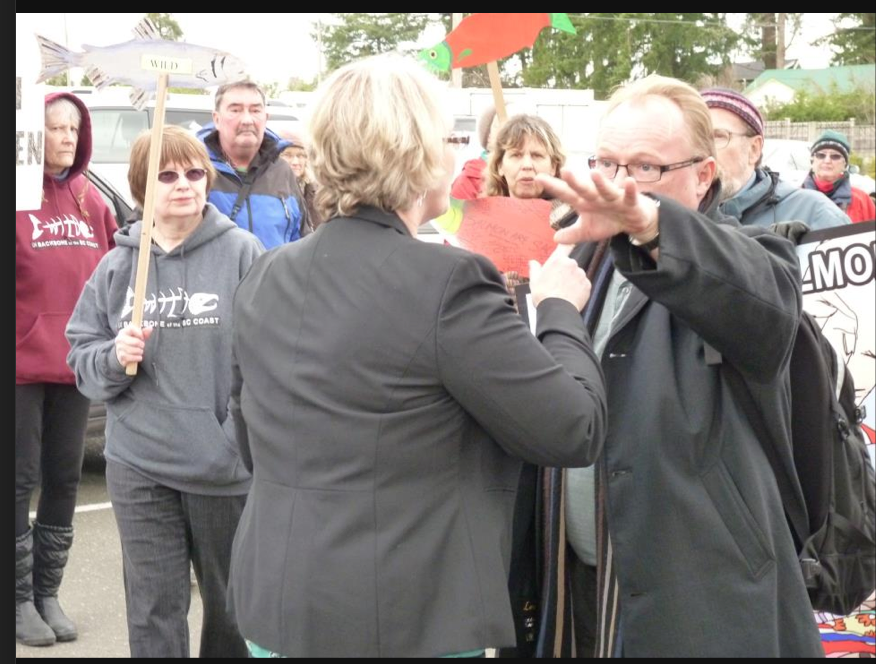
Then the situation turned bizarre, Laurie Jensen from Mainstream got into some kind of fracas with Per Sandberg as people looked on, stunned. Anissa’s camera caught the angry interchange as the man defended himself.

I also had a good conversation with Marianne Balto member of the Saami Parliament.
While we were doing the best we could to communicate Chief Bob Chamberlin, who was not invited to this meeting between First Nations and the Norwegian government did not let that stop him. Chief Chamberlin went in and sat with the president of the Storting and Saami leadership. I wish his village of Gwayasdums could see how they were represented this day. Chief Chamberlin has filed a Class Action Suit against the Norwegian fish feedlot industry.
As Geoff Gerhart and I got on the ferry to return to Quadra Island, a woman in a pickup flipped us the bird. She was likely employed by the feedlot salmon industry. I am sure she saw us as a threat to her livelihood and I can understand that, but her comment was that Americans fund us. To this woman I say – whoever is telling you this, is lying to you. Americans do not fund us. We are people taking a stand for wild salmon, because we believe they are important. No one is paying us to do this, no one can pay us to stop. We are people from towns failing under the globalized economy; we are people who care about the future of all living things that come after us. We are so low on funds, some of us hitch-hiked to be here today. We are single moms, people in wheelchairs, fishermen. You can disagree with us, but do not allow these corporations to pit us against each other with lies.
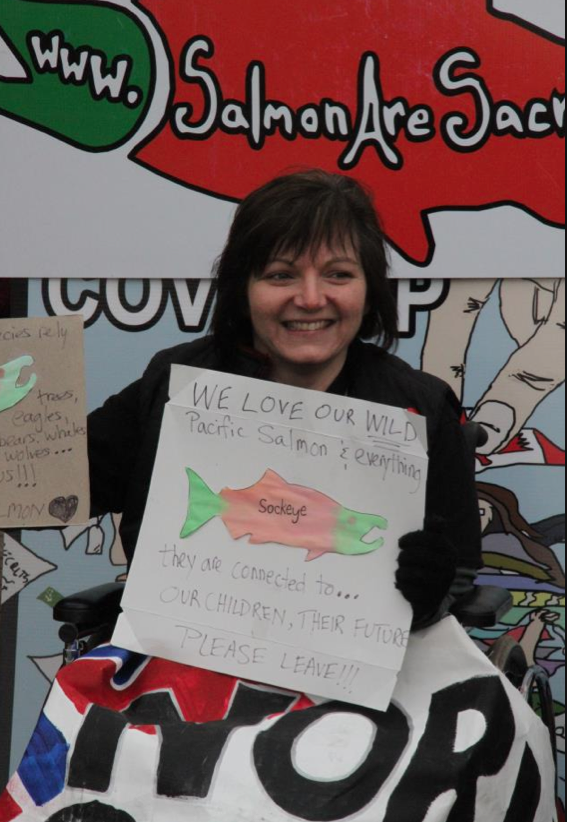
Salmon feedlots are dinosaurs, pouring massive amounts of wild fish into pens of fat Atlantic fish as if they will never run out. I would say to the angry young woman – don’t bet your job will continue no matter whether I stand on the side of a road with a sign or not. Trying to hold salmon in feedlots is just a bad idea that is running out of time. Their exploitation of global fisheries can’t last, there are not enough fish to sate their greed. They are playing games with THE most deadly salmon virus, an influenza that destroyed them in Chile – but apparently they did not learn from that. If you can’t see the value of millions of wild salmon pouring home to us every year, we can’t help you, but don’t imagine any of us standing there today profited from this – quite to the contrary. We are not the ones profiting.
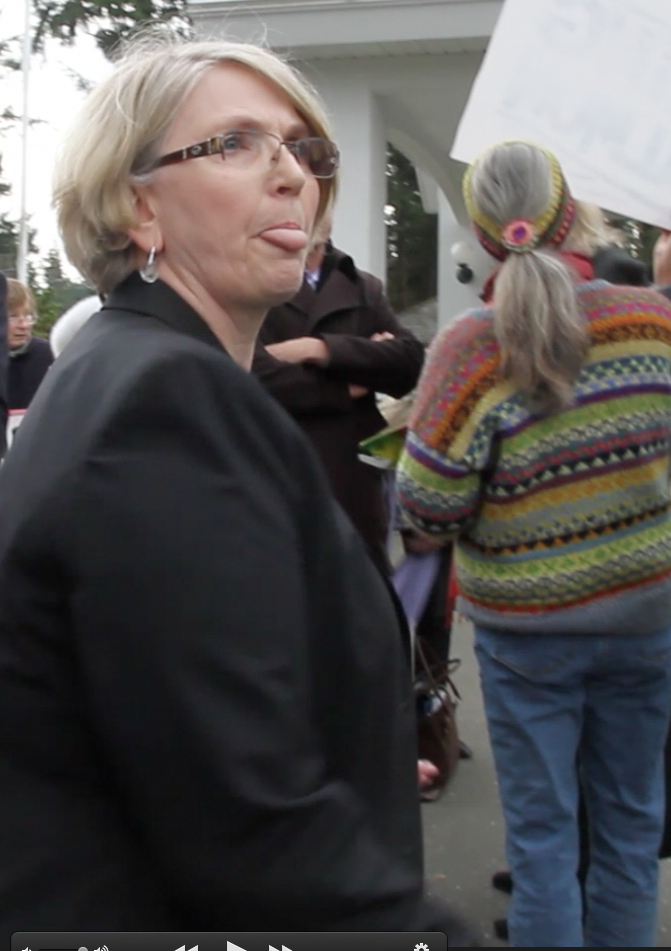
This photo of Laurie Jensen, Mainstream Canada Communications, sums my 23 years of experience with this industry. While Laurie seems to have anger management issues, she is at least honest in her display caught here amongst us in Campbell River. I feel the same response from the other companies, that it does not matter what you people want, this industry is going to pollute your waters. The people who live and belong to the waters between Kingcome and Knight Inlet have told the industry they don’t want it. They have served eviction notices in war canoes, filed a very costly Class Action Suit against them and yet the industry steps onto their lands however and whenever they wish. They do not allow us to look into the pens to see what the wild fish are inside, they do not let us test their fish. My community tried to be positive about their arrival, but had no say in where the pens were placed. We have no right to protect wild fish or our livelihoods.
To Donate: salmonaresacred.org
or:
Pacific Coast Wild Salmon Society
Box 399
Sointula, BC V0N 3E0

Comments
2 responses to “We meet with Norwegian government members”
Perhaps the Norwegian parliamentarians can explain why,at home, they and Norwegian companies espouse Corporate Social Responsibility (CSR) in Norway. Yet when the same companies, some with substantial Norwegian pension funds as investors, travel abroad, the companies behave as if they owned the local regulators.
They make fine sounding CSR reports yet they stick their tongues out at the local community.
Some serious comments are needed from the parliamentarians.
There is even an ISO standard (26000) that is a guideline for international companies – where does the fish farming industry stand?
-30-
A pity the Norwegian Auditor General’s report (referred above) was not on evidence at the Cohen Commission.
The report is in Norwegian but the English summary suggests that aquaculture environmental challenges have not been adequately addressed in Norway.
The Auditor General in Norway suggested the environmental challenges will require significant changes in ocean use management and the way aquaculture is regulated. Key measures such as production ceilings, permits and inspections are not being properly addressed. The existing situation does not address the overall objectives of sustainable growth in the aquaculture industry. (report summary in English)
After the Cohen Commission evidence, many of us can echo the same conclusions in BC.
Perhaps the aquaculture industry in BC, instead of pointing fingers (or tongues) at opponents, could tell us how it might address these same issues in BC and in their home state.
Not much to ask of multinationals who professes thorough Corporate Social Responsibility(CSR) programs.
Are the Norwegian parliamentarians listening in Norway (and while they are in BC)?
-30-