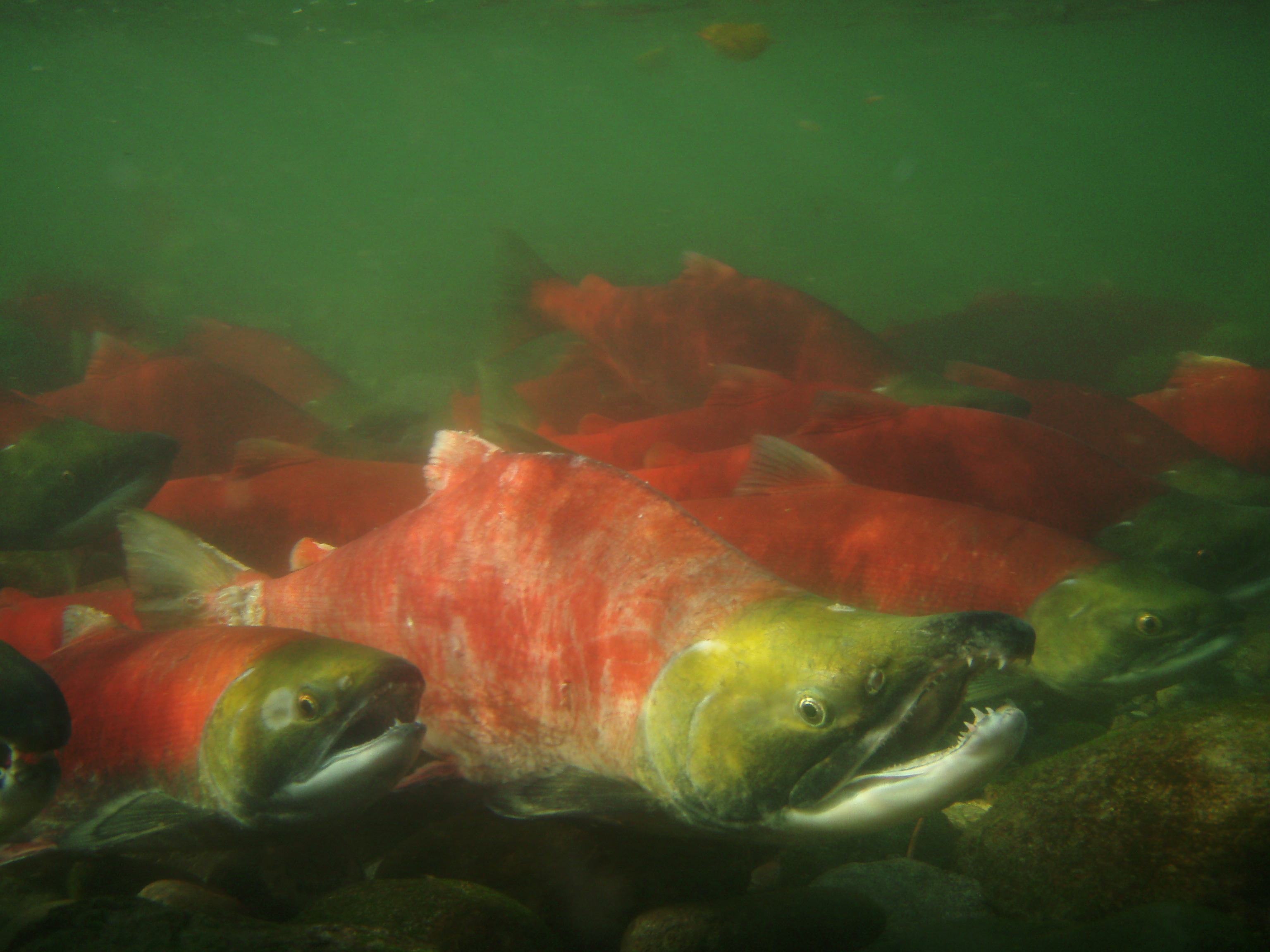
Dr. Miller was on the stand again at the Cohen hearing on diseases that might be killing the Fraser sockeye. Today we learned that a single salmon farm with 1,000,000 fish can shed 60 billion viral particles per hour during a disease outbreak. Work done by Kyle Garver (DFO virologist) modeled what this might look like in the Discovery Islands. This is highly relevant because the Discovery Islands are the narrowest portion of the Fraser sockeye’s marine migration route.
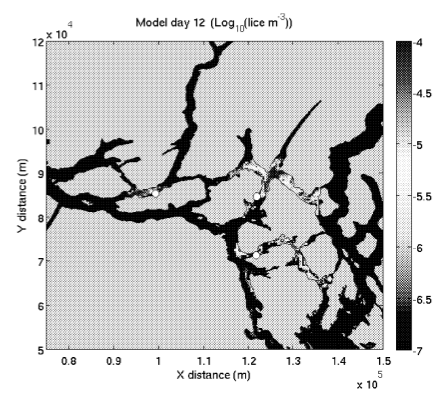
In this figure, black is water and you can see two white circles which represent salmon farms. The grey patchy areas are the “viral particles” leaving the farms and they completely fill parts of the channels. This means as sockeye travel through this area there would be no opportunity to avoid viral particles during a salmon farm disease outbreak. Salmon breathe by passing water over their gills, so the oxygen in the water comes into contact with their bloodstream. This means as a wild salmon passes through a salmon farmed region, salmon farm-origin pathogens leaving the farm fish’s bodies comes into contact with the bloodstream of the wild salmon.
Dr. Miller elaborated that Harrison sockeye, the one run not found in the Discovery Islands, had no evidence of the unidentified virus in 2008, 2009, 2010. However, Harrison sockeye not only avoid salmon farms, they leave the river before adult sockeye enter the river to spawn. They are unique in this way among sockeye, but they share this behaviour with both pink and chum salmon. While the sockeye, pink and chum salmon that went to sea in 2007 all collapsed, the pink and chum have not been on the same 18-year decline as most of the Fraser sockeye. Is this because they are not exposed to farm salmon pathogens carried into the river by the spawning generation? These are things we must learn about.
Greg McDade pushed to find out exactly how Fisheries and Oceans is responding to Miller’s finding that an unidentified virus might be killing 100s of millions of Fraser sockeye. He turned to Dr. Garver.
McDade: When a senior scientist [such as Miller] says there is a potentially devastating impact, what would it take for you to take some action, how far do we have to go for proof.
Garver: I would not recommend action at this time.
McDade: We saw in a memo to management that you made comments to water down the significance of her findings. Why would you try to water this down?
Garver: I gave my opinion and weighed the evidence, that is my job
McDade: Does your department have any guide whatsoever to take action, in the absence of final proof?
Garver: I believe we are doing something
McDade: Miller wanted to test farm fish and you resisted this
Miller: We didn’t have a disease agent and it was difficult to get across what a genomic signature is, the battle was that until we have an etiological agent we can’t ask industry to let us do tests. So I changed direction, to try and identify the agent [virus].
I went to Genome BC to see if they would let me change direction to identify the virus, they said they were uncomfortable and they said no. (It was not their mandate)
I went to DFO to ID the virus, the fish health experts were not comfortable, but now we have a candidate virus [parvo]. I am hoping things will be different now.
I was approached in February [after the SCIENCE paper was published] by Walling [director of the BC Salmon Farmers Association] she wanted to know more, there was some interest, but a vet with the fish farm industry said DFO advised against the testing. I let that drop at the time.
I went to Laura Richards [ADM of Science, DFO Pacific Region] to ask how to move forward. It was clear the fish health group were still uncomfortable at the time.
I had a second meeting with Thomson [Director of Aquaculture, DFO] he said he would take this to the leaders of the farms, he did discuss this with the CEOs.
This is an approximate record of her words which will be online as a transcript of this day on the Cohen Inquiry website http://www.cohencommission.ca at some point.
The Conservation Coalition Lawyer, Tim Leadem asked Miller about an email Miller wrote to Mark Saunders telling him that Laura Richards did not want her to indicate to the Pacific Salmon Commission that the disease was of “strategic importance” and in particular she was not to speak about the timing of this virus appearing in the sockeye (Exhibit 628).
Leadem: Do you think this strategy backfired?
Miller: I believe things have backfired, yes.
Leadem asked Miller why she was not allowed to present her findings at the Simon Fraser University 2009 Think Tank on the sockeye crash?
Miller: The worry was it would automatically be associated with aquaculture
Next Leadem turned to an email from Dr. Gary Marty the provincial vet who does the reports for the province of BC on the salmon farm health. In it she writes Dr Marty to ask about the farm salmon that die of pathogens that are never identified. She seems angry that he does not believe marine anemia, even exists!

If the one government vet who actually gets to examine farm salmon does not believe in marine anemia how is anyone going to know what is happening with this disease. If it is killing the majority of Fraser sockeye how will we ever know?
Leadem: Looking back have you been under pressure
Miller: Oh, very definitely, yes
Krista Robertson representing the Musgamagw Tsawataineuk Tribal Council of the Broughton, asked Miller about an April 23 informal proposal stating work that needed to be done asking for $18,700 to test Atlantic salmon to see if they carry the same genomic profile as the dying sockeye. If they do, that would be the first step in establishing the scope of this virus and possibly the source.
Miller: No money was given for this.
Miller: In my opinion we may be looking at a major fish health event
Miller: I have no funding to work on sockeye salmon at this time…
Salmon are sacred has decided to raise the $18,700 to take to DFO and insist that Miller test the genomic profile of farm salmon. We cannot allow DFO any excuse to not to test the farm salmon and this must be done before Justice Cohen makes his recommendation to Canada on how to keep the Fraser sockeye alive. If you want to contribute go to salmonaresacred.org and when you donate write For Kristi Miller.