October 19, 2009
Minister Steve Thompson, Ministry Agriculture Lands
Dear Minister Thompson;
The Fraser River sockeye collapse demands government action. Many spawning areas have zero returns which means this generation of some runs are now extinct. It is good to see your government is concerned (BC Environment Minister Barry Penner’s September 29 letter to Federal Fisheries Minister Gail Shea calling for a meeting and public review). We need to know what happened so we can remedy it before May 2010, when the next generation of sockeye heads to sea. There is something very specific only the Province can do that does not require the feds, meaning you could get started right now.
The 2009 Fraser sockeye crash is highly specific, affecting only the sockeye known to travel north along eastern Vancouver Island as juveniles. The Fraser sockeye stock known to migrate to the south through Juan de Fuca Strait is healthy and returned at twice the DFO forecast. This is a natural experimental design and highly informative. One river, one ocean, two migration routes. One migration route produced twice expectations, the other failed by 90%. There was a similar pattern in 2005 sockeye returns. In that case, we know that the northbound Fraser salmon that swam through the 2003 viral epidemic on the Campbell River and Port Hardy salmon farms did not survive well. The southbound ones that did not swim through an epidemic flourished. Did the 2003 IHN epidemic on the fish farms cause the 2005 sockeye crash? This is only a hypothesis based on a correlation, but it bears scrutiny.
Your Ministry was responsible for salmon farm disease monitoring in 2007. The MAL Fish Health Program 2007 report states:
1.1 Executive Summary
The Province of British Columbia maintains a comprehensive health management program for salmon aquaculture. The program includes a requirement for on-farm health management plans; mandatory monitoring and reporting of disease events and a British Columbia Ministry of Agriculture and Lands (BCMAL) audit of industry reported information.
These records are essential to the analysis of what happened to this year’s sockeye and how to correct the problem. If disease on salmon farms is contributing to these sockeye declines the good news is that it is easily remedied by removing salmon farms from the Fraser River northbound migration route. Your government wants action to protect the Fraser sockeye and you can play an essential role, no permission needed from the feds to do the analysis.
There are many large farm fish losses posted on the Marine Harvest Canada website 2007/9.
Brougham Pt. – lost 142,463 fish July 2009 (Campbell River)
Bickley Bay – lost 123, 297 fish July 2008, (Campbell River)
Doctor Island – lost 71,056 fish August 2008 (Broughton)
Raynore Group – lost 343,226 fish Sep. 2008 (Port Hardy)
Lime Point – lost 63,875 fish October 25, 2008 (Central Coast)
Jackson Pass – lost 661,367 fish August 2009 (Central Coast)
Okisollo Channel lost 500,000 fish Jan – July 2007 (Campbell River)
All of these losses were during wild salmon migration windows and we don’t know what is going on, on the Mainstream and Grieg farms. How many of these losses were due to disease? Your Ministry knows. We cannot manage wild salmon without knowing what is going on with the millions of farm salmon sharing the same ocean. As you are a member of a longtime farming family I am hoping you can see the reasoning on this. In the wild each generation dies before the next one appears and this breaks the cycle of disease. Fish farms, however, capture the disease of one generation, incubate it and pass it to the next generation. Wild salmon are not adapted to this and I think we are seeing the consequences in the Fraser River. You have the power to prove this theory wrong with complete disclosure of what all these farm salmon died of and what pathogens have been in which farm, when.
Others and I have done the science on this with one pathogen – sea lice. We now know that when the farms make a real effort to reduce their lice we get pink salmon back. The same dynamic is in play with bacteria and viruses and this cannot be ignored just because the NGO scientific community has not done this research as well. If we removed farmed bacteria and viruses, would the sockeye respond as the pinks have?
In addition, we have a Federal Minister of Fisheries who refuses to accept the science that ISA virus travels in salmon eggs and so she is allowing salmon eggs from the Atlantic into BC. The threat posed by an introduced virus is tremendous. Norwegian scientists tracking the ISA virus say BC is guaranteed to get the disease, if we continue with this unintelligent policy. Fish farmers don’t know what the other companies are doing and so your Ministry would be providing a huge service to test every salmon farm for ISA right now, including Clayoquot Sound. That way we don’t have to guess where we stand with this virus, which could change the status of wild and farm salmon completely, just look at the mess in Chile from ISA where 65% of all farm salmon have it. We know it spreads to the wild and there is no cure.
And finally, last week I received pictures of medicated salmon feedbags on a truck in a ferry lineup. The destination printed on the bags was Steamer (Point in Esperanza Inlet), the company Grieg. Since a withdrawal time was printed on the bags I was asked to find out if this drug is safe for the fishing public who can’t know when treatment started. They also asked me to find out what disease is being treated at this site? It would seem a reasonable request and a human health concern to allow drug treatments in facilities that release feces into areas where people fish and perhaps signage should be required to warn people.
Thank you for considering my concerns,
Alexandra Morton R.P.Bio.
http://www.adopt-a-fry.org
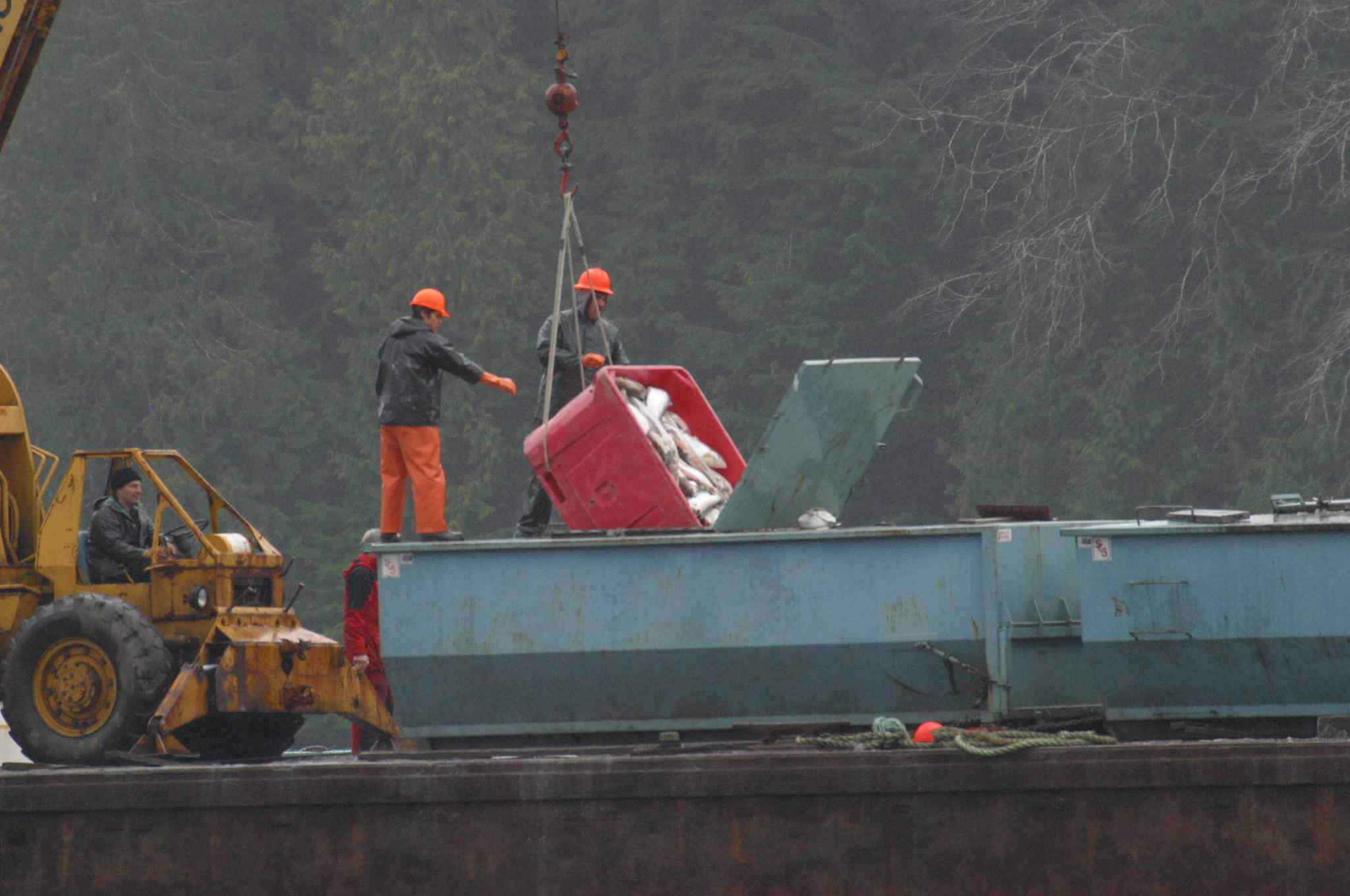
Dumping IHN infected morts at Sir Edmund 2003
Dear Minister Shea
October 14, Barry Rosenberger, B.C. Interior area director for the DFO’s Pacific region, is quoted in The Record:
“there has not been a salmon collapse in the Fraser,” “while this year’s sockeye return is the lowest in 50 years, Rosenberger said, “they’ve rebuilt stocks from worse cases in the past.”
http://www2.canada.com/newwestrecord/news/story.html?id=0d908438-f4e8-4ca8-8ac6-6fd447340ce8
On the same day Stephen Hume published DFO sockeye numbers to date throughout the Fraser River in the Vancouver Sun including:
Nechako River System – forecast 374,000……counted – 71 fish
Many creeks were zero.
http://www.vancouversun.com/sports/worst+years+history+salmon+still+killing+them/2099674/story.html
This is a collapse, these runs cannot rebuild.
This is third in a string of extremely misleading statements made by your department on the Fraser sockeye.
We need all of you under oath. There must be a judicial inquiry. This behavior is immoral.
Alexandra Morton