Yesterday I received an email from a friend who had heard that herring had been caught in a salmon farm and destroyed. I went to Beaver Cove with Robert Mountain of the Musgamagw Tsawataineuk Tribal Council. We looked at the Sea Soil site, where dead farm salmon are turning into “organic” fertilizer for gardens. There were lots of bears eating the rotting remains, but no herring visible with all the big machinery turning the steaming piles
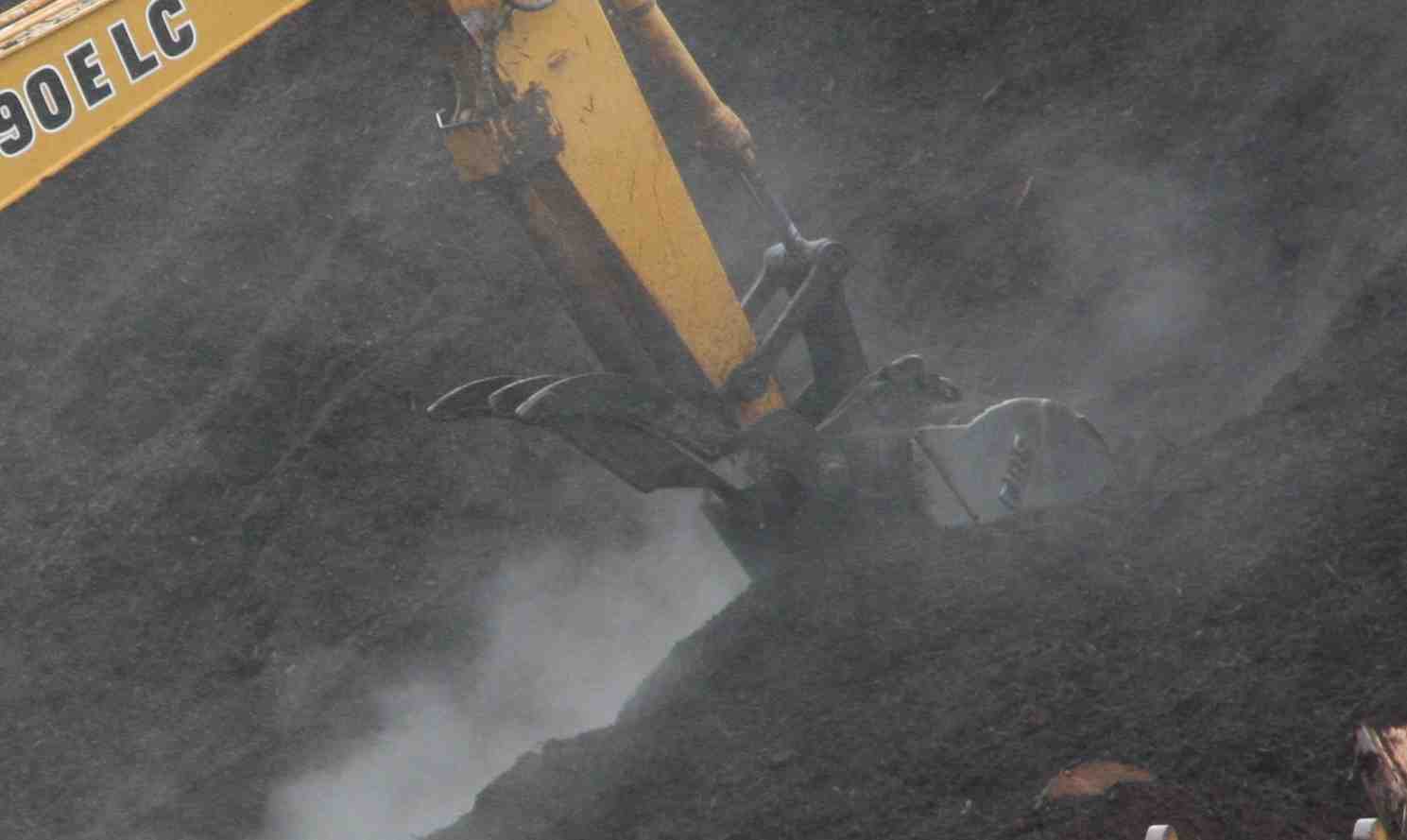
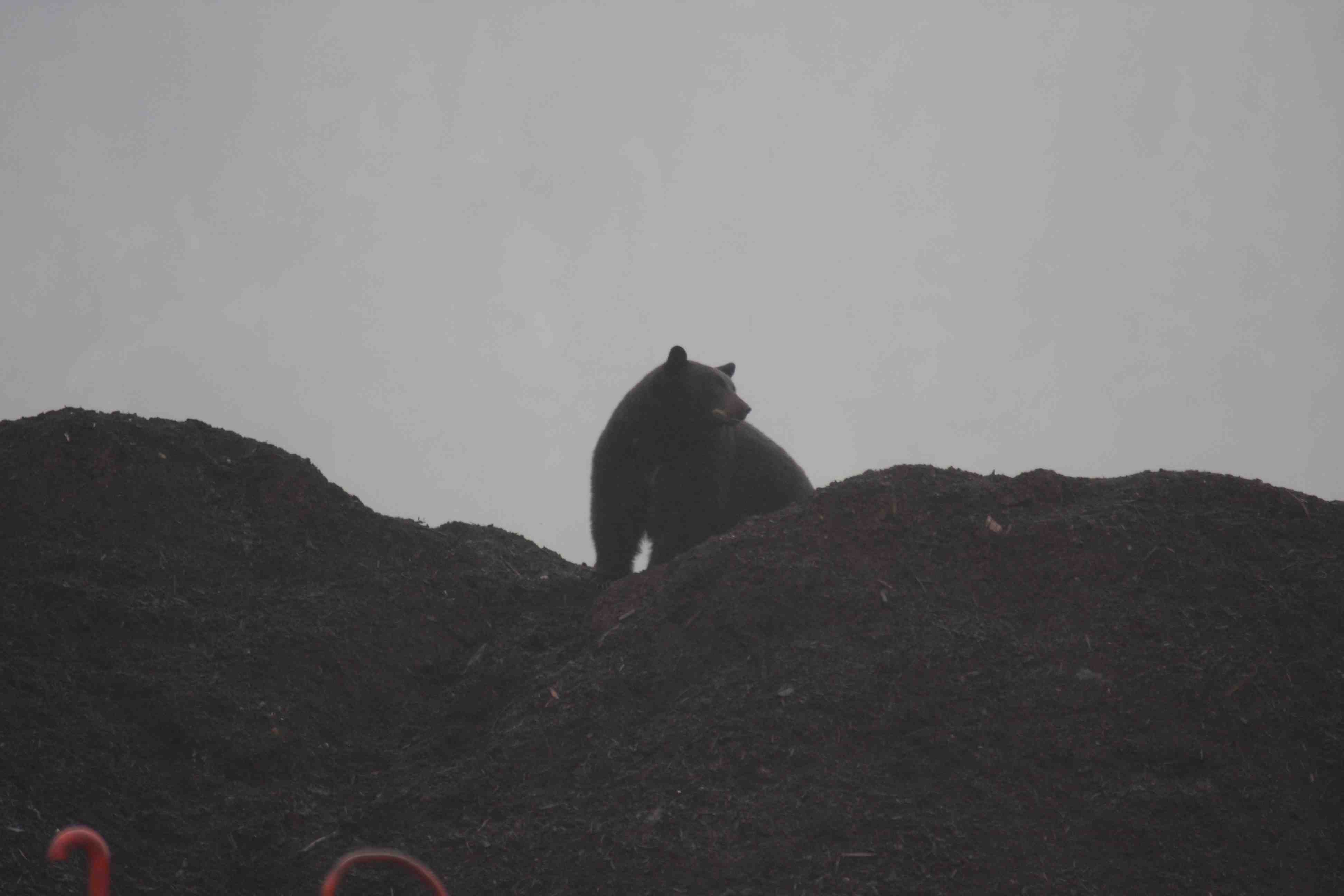
So Robert Mountain and I went to the Marine Harvest dock at Inglewood and spoke with a representative of Marine Harvest and the DFO enforcement Officer we had called. Marine Harvest said they had indeed caught small herring in their farm at Arrow Pass and during the sorting process these herring and some rock cod had been thrown into totes which were later dumped at the Sea Soil site. He did not know how much herring or rock cod had been mixed with the dead Atlantic salmon. He did know the herring were 3 – 10 grams.
The herring in this area have never rebounded since salmon farms moved in. A confidential DFO memo in the late 1980s warned of problems with herring around salmon farms. Recently, DFO simply stopped counting herring in the Broughton…end of problem for DFO.
The DFO enforcement officer seemed perplexed as to what should be done. It appeared to me that the herring and rock cod in the pens were not a concern, even though she did say it would not be legal for me to hold these species in a pen. It also seemed that because Marine Harvest had no license to harvest any wild fish, that it might not matter because… they were not in violation of a licence…. which they did not have.
On October 6, DFO posted a release on their website saying they fined a man, with no fishing licence, for possession of two Dungeness crabs – $600. The release goes on to say DFO acts to end illegal fishing activity. As part of this work, the Department asks the general public for information on activities of this nature or any contravention of the Fisheries Act and Regulations…..
So DFO you have been informed. Witnesses stood beside a DFO officer as she was informed that an undocumented amount of wild Broughton herring had been destroyed and dumped and unreported until several of us embarked on our own investigation. Marine Harvest caught and destroyed herring with no licence. They did the same with wild juvenile pink salmon 4 months ago, I believe you gave them a warning not to do this again….. Well they have done it again. Is it legal for salmon farms to kill wild fish without a licence or or not?
For all reading this please consider signing this letter telling the Minister of Fisheries to apply the laws of Canada to fish farms.
Reason must be brought to this situation.
Comments
45 responses to “It is time for DFO to decide: do the rules apply to fish farms or just to the rest of us?”
Excellent point! This is a huge double standard and illegal for good reason… I think DFO really stands for “Don’t Find Out”.
I have been talking about why we shouldn’t use “Sea Soil” for some time to people I know… and was amazed at all the eagles I saw feeding at the Beaver Cove location as well as one near Qualicum. Do they dump their diseased fish here as well or do morts have to be disposed of separately? Anyone know. I believe they should have to contain their product to keep wild life out.. in essence they are creating garbage bears and if anyone lived in McNeill in the early 80’s they will know there were dozens of dump bears that eventually were destroyed. It would be great if someone did a bit more research into this “Organic” sea soil and brought some light into what it really is. If there were observers at the farms we would know how many herring ended up in this fate as well. Perhaps some commercial fishermen and others could stand their ground in shifts as volunteer observers at the farms… would they be arrested and taken away?…Perhaps it is time to stage a sit in at the farms… and monitor 24 hours with live feed.. and let DFO deal with that.
Sounds like that old song heard it from a friend who heard it from a friend who…………….hearsay in a court of law
Alex,
There is an old axiom when people are trying to figure out why somebody’s doing something that doesn’t make any sense: “Follow the money”!
We know that the fish-farmers are benefiting, economically, from the DFO’s shameful disinterest–to put it kindly. But I suspect that the fish-farmers are not the only ones making a buck off the DFO’s lunacy.
If you know of a top notch forensic/investigative reporter willing to take this on, I have no doubt that he or she will find that someone (or many someones) in government are also benefiting, in some significant way, from the inversion of DFO’s charter.
Sad, but something that makes this little sense can invariably be explained by someone’s self-interest. Sic ’em, Alex!!!
Washington Angler : I doubt if Alex would take that on. It could be she would be the one proven to be benefitting from her actions. She continually refuses to disclose her funding. Someone or many pay her bills. Why can’t she say who she works for ?
Annie Paddle
Not sure why you say I “continually refuse to disclose” my funding sources as I have never spoken with you.
I pay my own bills lecturing, selling my books, selling my artwork, recently I sold my cabin in Echo Bay to make ends meet.
However, the legal fees I am paying out come from over 1,000 small donations to http://www.adopt-a-fry.org The People are paying for this as is right as these fish belong to the people.
But Annie Paddle, the scientific journals I have published in don’t care about any of this. They send my work out for review and base their decision on what these anonymous reviewers say. Fish farms are damaging wild salmon world wide.
Obviously, it would be great to get paid for what I do but you do raise a good point. One must look where the money comes from, which is why, for now, I am happy to be independent.
Alex:
You answered Annie Paddle’s (to use her words) “heresay”, with much more grace than I would have!
Knowing you as long as I have, anyone who would question your personal motives and/or integrity (interesting that the word integrity contains the word “grit” which is also one of your strengths!) is barking up the wrong tree.
There are published articles in the same journals that also discredit you and your findings. Your claims about the Fraser collapse are based on your opinions only. The Fraser runs have collapsed numerous times over many decades. I find it hard to understand why you use groups for support that out of one side of their mouth preach conservancy and then post on their own websites they don’t see how their group is part of the problem. Any user group is part of the problem particularly when they deny they are. ie Angler group posting to mega kill fish. Don’t feel they’re part of the problem so they should be allowed to continue fishing. NO ONE should be fishing natives included. You had commercial fishermen support your salmon circle yet those same fishermen are whining because they didn’t get to fish out of the other side of their mouth. Conservation can only happen when ALL user groups accept some responsibility for decline of salmon stocks amongst other possible scientific evidence BESIDES the ever vocal sea lice campaign
Annie Paddle: you claim there are published articles disputing the reasons given on this blog for the disappearance of the Fraser River sockeye. I would very much like to review these articles. In am interested in PEER REVIEWED, NOG and UNIVERSITY papers world wide! I have look long and hard for papers confirming the positive environmental effects of OPEN NET SALMON AQUACULTURE. If you do not wish to correspond here my e-mail is:
ibofs_restoration@yahoo.ca
Thank you in advance Gary
The issue of the fish farms and the vanishing sockeye goes right to the issue of whether common property resources are managed to the benefit of society or only selected groups in society. The issues Ms. Morton raises are serious ones and have been canvassed in peer reviewed international science journals. To suggest that these articles were written by Ms. Morton for mercenary reasons then published by international science organizations of long distinguised standing for equally mercenary reasons, does a disservice to the author of the ad hominen (ie personal) attacks on Ms. Morton.
Even the most partisan DFO fish scientist has never suggested, to my knowledge, any other than motives of science inquiry to Ms. Morton’s scientific papers.
The nature of science is that there are often dissenting views which are examined and resolved by scrupulous and independent attention to detail and evidence – a trait the DFO could usefully be reminded of. And that goes for the contributer Annie Paddle as well. Canadian citizens would be well served by either an independent scientific inquiry or an independent judicial inquiry where the issues can be canvassed and the evidence carefully scrutinised by independent experts and an unbiased adjudicator.
Dear Annie Paddle,
As another commenter explained science is full of differing opinions. This is why when people have submitted a rebuttal to one of the papers I have co-authored, the journal has also published our response. If you read these you will see the rebuttals were based on lack of clarity on which we further illuminate. This is also part of science, stacking blocks of knowledge, testing their strengths, finding the weaknesses. If you think that discredits me, I can’t help you, but I don’t see it that way. In addition, even if I were personally discredited, this would not change the well known dynamic between pathogens and feedlot populations of animals. They must be isolated from the natural system because they break fundamental laws which are the foundation for the cycle of the salmon and it predators. Salmon is a nomad and death after spawning breaks the cycle of disease.
Ms Morton and others : you miss my point. The fact remains numerous articles have been published over decades to try and explain what reputable scientists think happen to stocks that collapse. In truth many didn’t collapse they were just over estimated by fisheries. There was a meeting in Campbell River at which a fishery rep admitted to native food fishermen that the possibility was high that the method they had used for their count was flawed and had in fact counted fish that weren’t really there. ie had counted mud and debris as fish. I try to be objective and recognize that there are more than one possibility rather than simply point the finger at aquaculture. ms. Morton you were proven wrong on your appraisal that mainland pink stocks would be non existant by 2011 yet you turn it around and slap yourself on the back taking credit for the fact they came back in record numbers. These mainland humps have done this for decades. You are a mere newcomer and don’t know anything about what went on regarding them prior to you coming to Canada.
Gary, There are no published articles as yet regarding the 2009 Fraser sockeye run. I base my opinions on the fact that these runs collapsed numerous times since 1905 long before any fish farms were present. These runs have had to fight over fishing prior to our 200 mile limit, illegal foreign driftnet fisheries, the US/Canada difference of opinion on the AB line on the Alaska border and a whole host of others. These runs have failed to return one cycle then came back in record numbers on the next. There are published articles regarding the collapse of salmon stocks in California that site over 47 potential reasons for the collapse.
Annie Paddle: You have stated it again!! WHERE ARE THESE PAPERS???? Not he said, she said, they said but PEER REVIEWED, N.G.O/PHD/University studies backing up your statment???? Trying to paint Ms Morton as an ill infomed outsider will not work. The Salmon Aquaculture Industry has DESTROYED the wild salmon stocks where ever they set up business. What is happening in BC is no differant than what happened in New Brunswick & Nove Scotia! If you want to be taken seriously please supply the information!
Annie Paddle: SORRY we must have been posting at the same time and I did not see your response before I posted. So are you saying there is no published data supporting your position on the run failures past/presant into the FRASER?
“Annie Paddle”,
Yes, wild salmon populations have fluctuated, but the annual sea lice epidemics that come and go with your fish farms and whether they use drugs or not, have not been a part of this coast.
Millions of Atlantic salmon on wild salmon migration routes are new. The affect of these feedlots on pathogens is new. The ISA virus plaguing your industry is new. The use of lights that attract wild fish to the 600,000 or so fish predators in your pens are new.
This issue is easily resolved. Fish farmers open your doors and lets have a look at what is in your pens from wild fish to pathogens. If there are no problems this would be end of subject.
And “Annie”, why not tell the folks on this blog what your real name is…..
Annie Paddle: I agree with you! the runs into salmon rivers swing wildly up & down! With the arrival of OPEN NET SALMON AQUACULTURE the swing has changed dramatically!! In one river on which I ran a counting fence for 20 years on my own dime, the wild stocks began to follow the EXACT statistical pattern identified by M Krkosek from the University of Alberta. Prior to the farms we had highs and lows but always enough to sustain the genetic diversity and population levels. With the arrival of the pens it changed!!! Each year we loss of 1/2 the river spawning population & so followed the smolt output from each river! IT WAS BLACK & WHITE!!!!
This has resulted in ALMOST COMPLETE EXTINCTION on 32 rivers!! The only native populations left are in CRYOGENIC SUSPENSION at a hatchery facility!!
I am troubled.
I am troubled by the posting by Annie Paddle, where he/she stated that Ms. Morton was a mere newcomer and did not know anything that went on prior to her coming to Canada.
I did not know that only Canadian born observers were the only ones permitted to know anything. I did not know that only Canadian born observers were permitted to observe, analyse and draw scientific conclusions. If this is the sort of illogical reaction engendered by the efforts of Ms. Morton and others to draw attention to the ongoing west coast fisheries problems, then the effort by Ms. Morton and others is succeeding because the fish farm proponents seem to be engaging in disinformation.
And increasingly, this appears to be is the tactic of choice for the fish farm advocates.
Gary : I stated there are no published papers regarding the return of sockeye this year. If you searched the internet and DFO you could find publications with the old data in. And Ms Morton, My real name is Annie Paddle. Sorry if you don’t like my last name. it is common in the maritimes originating in Ireland and later England where my family fished herring out of Lowestoft Suffolk prior to 1900.
Gary : you don’t state where you are situated. To my knowledge there are not 32 rivers in BC with extinct populations of salmon. Perhaps one I do know of is just outside Squamish where the train derailed and dumped toxic chemicals into the river . it was believed at the time the entire run was wiped out that year . I’m not sure of the date but if you search chemical spills Squamish you should find it on the net. As for the farmers engaging in disinformation I refer you back several years to the farmed and dangerous campaign where Ms Morton showed photos of fish covered with sores and broadcast to the world that this was the product the farms were selling to the public. Absolute rubbish. As if anyone would purchase fish in that condition. Sensationalistic tactics to scare an unknowing public.ms Morton at one time claimed to be a graduate of American University in Washington DC later claimed to dropped out of another university without completeing her studies and now states she is “self taught ” So what is it
Gary : refering to your he said she said comment I believe it applies to the statement from Alexandra Morton at the beginning of this piece I got an email from a friend who had heard that >…………..You call that factual ?? Be patient ……..the information you seek may soon be posted.
Annie Paddle: I am not in BC but in NB. We had the BC situation LOOOOOOOOOOOOOG before you did.That was after Scotland, Norway and yes: your home land, Ireland passed the problem along. The situation here is a closed loop. No high sea fishery, small provinces and closely watched river systems. The Open Net Salmon Aquaculture appeared here in 1978 and by 1986 our wild salmon populations were in DRAMATIC decline across all 32 rivers. In 1996 the AQUACULTURE INDUSTRY brought ISA into the bay, carried in the eggs from Norway! The ISA outbreak lasted until 2006 we think because, Aquaculture/Government here will not release information either!! ISA was NEVER found in our wild salmon up to that point!!!!
WHAT ARE THEY HIDING????????? If everything is OK open the farms and the books for all the world to see. Show those of a differant opinion they are WRONG!!
Now all of our native salmon populations are on the Species at Risk list. DFO tell us it is MYSTERY what happens to our large healthy smolts leaving their rivers!! SOUND FAMILIAR?? Just up and disappear at sea!!
None of the Inner Fundy wild salmon migrate to the high sea. They are genetically programmed to migrate and feed right into the middle of the Aquaculture salmon cages. In our case it takes 5 lice to kill a healthy smolt not 1 or 2.
You seem to know about the Industry in BC:-)! Where are they importing their Atlantic Salmon eggs from?
nomlas : The eggs come from the aquaculture industry’s own brood stock here in Canada. They have several hatcheries. Unlike you our stocks were already in trouble long before the fish farms arrived. Yes there were many screw ups in the early days but the companies continue to work hard to lessen their impact on wild stocks. ms. Moron’s claim about this year’s salmon run is unproven. These stocks have crashed numerous times since 1905. There was a slide on the Fraser I believe in 1914 at which time the US paid money to rectify and ever since then we have had to give them 50% of the allowable catch. We have to contend with a war with US on the Alaska /BC border over what is called the A/B line. Canadian salmon come in there and many are licked up by the US commercial fleet then again on the BC/Washington border. We have the illegal driftnet fleet known as the wall of death, we have heavy industry on the Fraser itself on the mainland a huge sports fishing industry who takes NO blame for declining stocks and we have the native food fishery which comes before commercial fishing.Fraser stocks crashed in 1950 coming back by 1954 and then record runs in 1958. Scientists could not explain it. We had a crash in the Albernie inlet in the 70’s when we had El nino and the river water was so warm the sea lice multiplied so quickly they totally devestated the run.It is known that lice breed prolficly when water temp is high and there is high salinity. You see I know facts going back for decades prior to Ms. Morton even dreaming of studying sea lice which is about all she seems to study. This is why I discredit her because she doesn’t evaluate previous scientific facts . She has only studied sea lice since early 2000 and doesn’t seem to want to consider any other factors or even acknowledge there are other factors.
Ms. Paddle:
I am sure Ms. Morton is more than capable of defending herself.
But before you go off on a tangent and allege Ms. Morton has uncertain qualifications, I should point out that she is registered as a Professional Biologist (R.P. Bio) in British Columbia which shows that Ms. Morton has a certain element of training and experience to qualify as such. Perhaps you should check the College registry for evidence.
As far as previous scientific facts are concerned, you may misunderstand the nature of scientific inquiry. The nature of scientific evidence can change and it takes an open mind and good evidence to overturn scientific orthodoxy. The world of science is full of examples of organizations that embrace scientific orthodoxy but lack the flexibility to address new and unsettling evidence. That is the situation with the sea lice issue and, with the exception of Ms. Morton and her scientific colleagues, the DFO science establishment for one seems to me to be impervious to the fresh evidence that overturns conventional theory. And that is why the issue of the fish farms and the sea lice issue has to be established in an independent forum, free for organizational impediments.
But please do continue to argue your side of the equation. That is all in the nature of dialogue and while I may diasgree with some of your points, you are arguing them as you see it.
You raise a good point and one which I have questioned DFO on many times. Which came first The Chicken or the EGG!
YES sea lice can transferred to the farmed salmon from wild fish. Milloins of farmed salmon are locked in ONE location. The opportunities for the sea lice to feed and breed are way beyond that of the natural world. In Maine the stress from treatment for sea lice on the farms brought on ISA. The wild stocks are swimming around OUTSIDE the pens. Who is treating them for the disease and parasites coming out of the cages?
There is an answer to this problem and it is CLOSED CONTAINMENT. I have been in contact with many of the European Manufacturers of these systems. Prelin.no has one of the most interesting. It is a closed system which give a 15% higher growth rate, 30% less fat in final product,gives higher fish densities, 20% better feed conversion ratio, had no morts during trials 100% escape proof and reduces pollution through collection of fish waste. This system would be far superior to what is going on out there now. I would send you the PDF so you can see that there is an alternative! Give me an e-mail address if you are interested.
This does not have be a situation where the political winner takes all! There is no reason why for this industry to exist we have to give up the wild fish which belong to everyone.
Nomias:
If you access on the internet, the Proceedings of the Royal Society of London (one of the world’s premier scientific organizations) you will find the following paper (below), published on October 7, 2009 on the sea lice issue. It is a masterful summary of the scientific literature that we all can read with some insight. The author of the paper is not without scientific credentials.
Now can any one tell my why, according to the DFO orthodox scientific conclusions, do sea lice behave differently in BC from anywhere else in the world ?
Draw you own conclusion.
PAPER:
Proc. R. Soc. B 2009 276, 3385-3394, October 7, 2009
Mark J. Costello
How sea lice from salmon farms may cause wild salmonid declines elsewhere in Europe and North America and be a threat to fishes elsewhere
Hey all
Great debate, when the timer runs out on this post please move to another one. For the record I am registered Professional BC Biologist #1414, and graduated Magna Cum Laude from American University, I did drop out of high school and I did finish my University long distance.
But this is not about me, Annie this is about an industry that has been associated with the same serious problems worldwide and needs to upgrade. They are feedlots. Pathogens multiply in feedlots and no one should allow wild animals in contact with feedlot populations for this reason. Bakke and Harris 1998 call salmon farms “pathogen culturing facilities.” I think every fish farm in British Columbia should be tested today for ISA virus.
Do you agree?
Thanks Helmsdale!! Do you have an e-mail where we could communicate. If you could, would you send it to
ibofs_restoration@yahoo.ca. Thanks
Thanks Helmsdale!! Do you have an e-mail address where I could send you information? Could you contact me at ibofs_restoration@yahoo.ca
Ms Morton, If ISA was on the farms the fish would be dropping like flies. NO ONE wants ISA farmers included. As for your comments regarding wild animals near feedlots it is rubbish. obviously you never grew up on a farm where elk and deer may mingle with cattle, horses etc at will. You would have every fish and animal penned up it seems because they MIGHT cause disease. I see you’ve gotten over my last name ??.
The Norwegian fish farmers presumably didn’t want ISA in Chile either, but it followed them there.
If the fish farmers do not have ISA, then a Province-wide testing should be fine with Marine Harvest, Grieg and Mainstream, correct? I see they are “following” your tweets, so perhaps they will weigh here themselves.
Alexandra : Your obvious problem with Norwegians is beginning to sound more personal than anything to do with salmon.
Ms. Paddle:
There are a good number of observers on the west coast who are sceptical about the regulation, oversight and management of our fisheries resources. It just happens that the Norwegians dominate the world salmon aquaculture industry and thus our comments focus on corporate social responsibility. It is merely that these corporations are Norwegian. They could equally well be headquartered elsewhere and we would still look at their record.
In any case, it is a well tried legal tactic to attack the credibility of a person when one cannot mount an evidence based attack.
That said, you have enlivened the blog exchange.
While I am not in agreement with many of your points, they do trigger thought and reaction.
Helmsdale : The fact still remains Ms. Morton hasn’t proven that sea lice caused the collapse of the Fraser run this year. it is her biased opinion. These stocks have collapsed numerous times due to high water temp ie El Nino which we have this year. They have not spawned because of high water temp and have even died from fungus before spawning. There remains too the fact that the DFO consistanly err on the return numbers. Please don’t think I have been defending the DFO because that is not my intent. I am not young and I have seen these stocks collapse over and over again over the past decades. The DFO has notoriously over predicted runs and then downgraded them. I know for a fact that there was a meeting in Campbell River and the DFO admitted their numbers were probably way off. I know this first hand from someone who attended that meeting. As is the way of DFO Ms Morton provided them with a scapegoat when she immediately begins her sea lice song and engages the Stollo and Musqueam to support her. Every commercial salmon fisher who has ever fished inside the Fraser knows that these Indian bands have some of the worst poachers in the industry. Mulroney sold out the commercial fleet when he granted them the right to sell food fish. The fishery has gone steadily downhill ever since. There are videos on YOUTUBE from fishes with rod I believe that show natives setting an illegal gillnet during a closure.
All: I find it somewhat hypocritical that on one hand Ms Morton has taken the Provincial/Federal governments to court to force the DFO to manage aquaculture and as soon as she achieves it she begins a new rant that the DFO needs to have a judicial enquiry into how they are run ? Most contradictory if you ask me. She wants them to manage it but doesn’t approve of how they do it ? Then why force them to mismanage it ?
Ms. Paddle:
The point made by Ms. Morton is that the sockeye that outmigrated past the fish farms were devastated while other stocks were, seemingly, unaffected. That calls for an explanation.
Fish farm sea lice predation is a plausible cause. Equally plausible are disease and viruses carried by the sea lice themselves that then infected the outgoing sockeye and other wild fish, making them a target for predation.
We need high quality research and monitoring and none of that seems to have been performed by the provincial and federal regulators = who can correct me if I am wrong.
The DFO forecasts are always quite questionable. I have never worked for the DFO but I did work as a regional economic planner in the UK many years ago, before quitting in disgust. Quite routinely, senior planners would fudge forecasts, to make senior management and their policies appear more valuable in the eyes of their political masters. Does this happen at the DFO? Who knows, but it is not beyond belief that the optimistic returns forecast this year were based on internal political dynamics rather than external ecology.
Only a judicial inquiry will resolve this.
And if I was a rogue drift net fishboat skipper, I would have been intercepting part of this alleged bounteous 2009 Fraser River sockeye return in the Gulf of Alaska, relying on the DFO forecast as a guide, and further reducing the sockeye return.
The combination of factors of arguably, inflated forecasts of escapement and return, arguably, sea lice and disease impact on outmigration and, arguably excess fishing effort in the Gulf of Alaska, has been deadly. The Fraser River sockeye stocks may now never recover.
In today’s Vancouver Sun, columnist Stephen Hume weighs in. Read it. It is a chilling analysis.
Quote:
It’s one of the worst years in history for salmon, and we’re still killing them:
By Stephen Hume, Vancouver Sun October 13, 2009
Call it British Columbia’s Silent Fall. Some of the most prolific spawning grounds on the Fraser River are showing minuscule returns from record brood stocks four years earlier……………………….
………….One thing seems clear. We need answers. We need them fast.
-30-
hello helmsdale, You have gotten my point I see at last. I have lots of material indicating quite rightly so that the DFO make some wild predictions. Equally they have underestimated runs and then upgraded them too late for the commercial fishing industry. There is another predator at large too. I only learned of it myself last evening. national geographic special. Search Alaska salmon sharks on the internet. They are believed to consume 25 % of returning salmon in Alaska and apparently run all the way to California. The entire Pacific coast has seen declines in salmon for years from Alaska runs all the way to California fishing grounds. There is little known about them only that they feed voraciously on salmon prefering pink salmon and also many other commercially caught species. They are up to 700 pound at maturity and some larger. .
Ms. Paddle:
An interesting question.
But it still does not explain why the sockeye that migrated past the fish farms were decimated while other sockeye and pink stocks were barely affected. I am sure the salmon sharks were/are not that selective.
Still, those that produce the alleged statistics at DFO have a lot of explaining to do. Quite simply, the DFO’s structure between the various departments seems to resemble silos rather than a smoothly functioning and integrated regulator (which they tell us they are, but the evidence points to another conclusion).
Helmsdale : You cannot ignore the fact that the pinks in the Broughton came back in record numbers. This has been repeated for decades and the mainland pinks are probably the most studied of all salmon in BC. There were lots of programs in place for decades to protect them. They have historically fluctuated wildly on opposite years of the run. Ms. Morton forecast they would be extinct by 2011. She was wrong as many of us already new she would be proven to be. There are NO salmon farms in the North yet their runs didn’t materialize this year either. Rivers and Smiths inlets were decling forty years ago. Long before salmon farming was even thought of. There simply must be other factors at play. Salmon farms are just too convenient a target.
Ms. Paddle
But when you impose an anthropogenic factor (ie sea lice, disease and pollution associated with fish farms) on top of a fish migratory route and other natural factors, there may be a risk cascade and a tipping point that brings the fish stocks to parlous levels. And badly located fish farms may well be that tipping point.
That is not rocket science. And if our fisheries regulators (ie DFO) addressed risk factors and designed the appropriate monitoring strategy, we might have some answers. Instead we have a litany of what the DFO tells us is not responsible for fish stock extirpation but they cannot tell us what does cause extirpation.
Despite the well known scientific expertise of the the DFO scientists, the science and evidence basis for many of the DFO regulatory decisions seems to me to be missing or deficient. The corporate culture at the DFO, at least in BC is sufficiently opaque and murky, that they quite simply have lost the trust of the ordinary citizen. Whether they have lost the trust of the fisheries commercial, recreational and aquaculture segments is an open question for another time.
My argument is that unless the DFO moves away from their lack of transparency, they will never recover from the lack of public trust, whioh may also extend to other federal organizations.
Much as I enjoy our exchange of views, I hope some of the “lurkers” out there in the internet world will weigh in on this argument and exchange. I do not want to hog the debate.
1- precautionary testing of all salmon farms using Atlantic salmon for ISA virus is very important
2 – the pink salmon extinction prediction was based on nothing changing… the fish farmers have since embarked on active delousing every spring that was not in place when the prediction was made.
3 – the sockeye collapse pattern was highly specific and so the cause is likely point source
4 – the disease records of the fish farms in 2007 must be made public or we will never know if they are responsible for the sockeye collapse
Ms Morton : you have changed your tack yet again. Now you question whether there was disease in 2007. By the way how old did you estimate the sockeye juveniles to be at the time of your study in 2007
helmsdale: it is known that sockeye return every four to five years. it is possible too that many simply didn’t return this year because the water temp was too warm. It has happened before.
Alexandra Morton makes a good point on disease testing.
It is all a question of assessing and recognizing risks and taking precautionary measures. Has this been done in BC by the regulators with respect to fish farms ?.
In the absence of the relevant data, a reasonable conclusion that might be drawn is that the oversight regulators have been indifferent to real and perceived risk and arguably, have not lived up to their public interest mandate.
We all recognize, I think, that any fast spreading virus which was transmitted from farmed to wild fish would be an ecological disaster in BC. Not only that, it would be an economic disaster for the fish farm industry, the commercial fishing sector, the processing industry and the international trade in wild salmon products. Not for one minute would the USA tolerate widespread trade in fisheries products from a region where there was a virus outbreak, with trade and ecological implications.
In the case of ISA, as I understand it, ISA was detected in Chile in coho farmed salmon in 1999 (where did that come from?) but it was not until 2007 that there was a massive outbreak in farmed Atlantic salmon. Conventional wisdom was that the ISA virus did not transmit from fish eggs and was not carried by sea lice. As I understand the science as it stands (correct me if I am wrong), the ISA virus can be transmitted through fish eggs, is seemingly capable of being transmitted by sea lice, and has some potential for mutation. Conventional wisdom is that the risk in BC is small but is not negligible but conventional wisdom was in error in the case of the Chilean outbreaks.
A prudent regulator in BC would demand, even if the risk was low, an ISA sampling strategy, a consistent biosecurity protocol and a governance regime that called for independent audits. The prudent regulator might expect that aquatic veterinarians, as qualified persons, would act in the public interest where there was detectable ISA or any other fast spreading virus.
Where are the biosecurity audits? Where are the reports by the independent aquatic veterinarians? Let me know if you know where to access these.
In my brief look at the scientific literature, I was struck by the question on the role of sea lice as disease carriers to other species as well as their direct impact on juvenile salmon. Given that risk, whether or not ISA is present in BC, we, the public , might expect that there be some tangible evidence that the fish farm producers and the oversight regulators, would have verifiable and independent evidence that supports the assertions they make on low or negligible risk of virus transfer.
Will it take nothing less than a judicial inquiry to access this information?
Please tell me.
Helmsdale : I believe the original question was should the fishery act be applied equally to everyone ? You have steered this blog far off the orginal topic. Ms Morton took the government to court and forced the issue of whether aquaculture is a fishery or not. Although I personally believe the judge erred in his judgement he nonetheless found fish farming to be a fishery. ALL commercial fisheries have bycatch. purse seiners may inadvertantly wrap around dolphins or seals when pursing up their nets, shrimpers catch everything from sole to prawns to dog fish in a beam trawl, crabbers and prawn fishermen catch snails and other small fish occasionally, sockeye gillnetters may have a spring salmon roll up in their net. The fact is a certain amount of bycatch exists in any fishery so hence the herring in the original question would no doubt simply be deemed as bycatch.
Ms. Paddle:
I thought the thread was an interesting exchange but if you want this particular thread to stick to by-catch discussion, we can resume the other debate on a different thread.
By-catch is always a problem for capture or farm fisheries. But in any prudent fisheries policy assessment, the by-catch has to be identified, and where practicable, restricted. A prudential and risk based fishery policy does not have unrestricted and unquantified by-catch policies, otherwise it is not risk based, and, it is a source of risk itself
But in many cases, the by-catch is monitored (it provides significant incidental fish stock information), it is monitored by independent inspectors, and to the extent practicable, gear is designed to minimise the by- catch and to the extent practicable, the fisheries effort is tailored to minimise incidental by-catch impact.
Is this done in the British Columbia salmon sector ?
Count me as sceptical but I see very little published evidence that the farm fish industry operates in a systematic marine planning environment. The fish farms are where they are primarily to have low cost access to processing and transportation infrastructure and to have sufficient tidal dispersal of pollution. The fact that the preferred areas are migration routes for other species is not, as far as I can tell, assessed as a significant risk otherwise there would be a far more robust marine spatial strategy. If the fish farm location policies had any cognisance of by-catch issues, there would, or should be, independent monitoring and inspection, including assessing incidental impact on other species directly or indirectly through disease dispersal.
All I can ascertain is that because the oversight regulators deemed the risk minimal, there is limited by-catch assessment in the fish farm sector in BC. In the absence of hard data to back up that conclusion (as far as I can tell) interested observers such as readers of this blog, are left with the idea that a significant risk to wild fish stocks, including salmon, is not being addressed and instead is dismissed with rhetorical shibboleths by the various special interests.
I am familiar with some of the marine spatial planning issues in Norway and Scotland. But what makes the SW BC fish farms different is that they are juxtaposed with major fish species migration corridors and the oversight planners are, seemingly, either indifferent to the by-catch issue, or if they have evidence, are quite satisfied with drawing policy conclusions without ever revealing the evidentiary basis.
And we are expected to be deferential to policies that are or have been developed in an evidentiary vacuum.
Count me as sceptical.
If any readers can direct me to published BC fish farm by-catch species and virology information, I would be very grateful.
-30-